UPSC CSE Exam 2019: Admit Card, Syllabus, Result

Dear Readers,

Current affairs forms an important component of several competitive exams such as the UPSC Civil Services Examination, SSC CGL, Bank PO & PSU entrance tests, etc. Therefore, understanding terms/concepts/events that are in the news is critical for aspirants. We at PaGaLGuY bring you this series of articles explaining some of these important concepts/events in detail.

In this article we are discussing the other cosmic bodies in our Solar System.

Asteroids:

a) Asteroids are small cosmic bodies which orbit around the Sun in a elliptical path. They occur in large number in belt between Mars & Jupiter.

b) They are made up of rock , metals & some organic compounds. They are also known as planetoids or minor planets.

c) Some asteroids have moon of their own.

Comets:

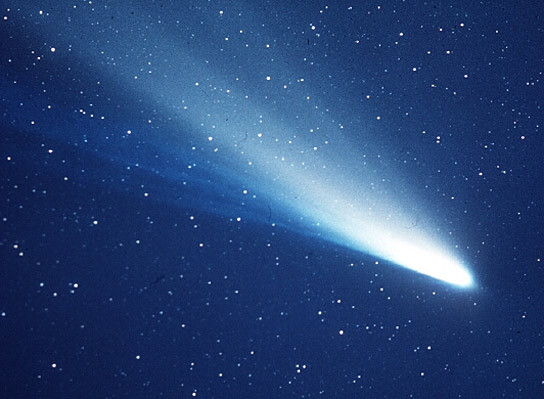
a) Comets are Kuiper Belt objects.

b) Comets are mixture of ice, frozen gases & dust.

c) Comets are formed of a special class of cloud present in outer solar system called as Oort clouds.

d) A comet consists of five parts; Nucleus, coma, hydrogen envelope, dust tail and the ion tail. The main part of the comet is the nucleus (head) which is the solid part of the comet.

e) The gas tail forms when charged particles from the sun, called the solar wind, push the cometary gas particles directly away from the sun. The gas tail is visible because its particles glow after being excited by solar radiation. The direction of the tail is always pointing away from sun.

f) On the basis of their visibility, they are divided in 2 groups. They are,

Periodic Comets                                                 Non periodic comets

They revolve in elliptical orbit.             They revolve in open parabolic curve.

They follow a certain path.                   They get deflected from their path after

                                                                their visibility.

g) Halley's Comet is well known comet. It is visible after every 75-76 years.

h) Shoemaker-Levy 9 comet was originally located by astronomers Eugene M. and Carolyn Shoemaker and David Levy in March 1993.

Meteors :

a) Also called shooting stars, they are a bright streak of light usually seen in the night sky. 

b) These are fragments of rock orbiting the Earth outside its atmosphere.

c) When they are pulled by gravity, they enter the atmosphere and approach the Earth's surface.   

d) During this friction with the atmosphere they generate heat. This causes these rock fragments to burn and produce light.

e) Sometimes they don't burn completely and reach the Earth's surface. They are called meteorites.

f) For this reason, the outer surface of our spaceships are laced with pure Silicon, which prevents the a spaceship from heating upon its friction with the atmosphere.

g) DRDO used Carbon-Carbon fibres on the outer surface of the Agni missile to prevent atmospheric friction. 

Black hole:
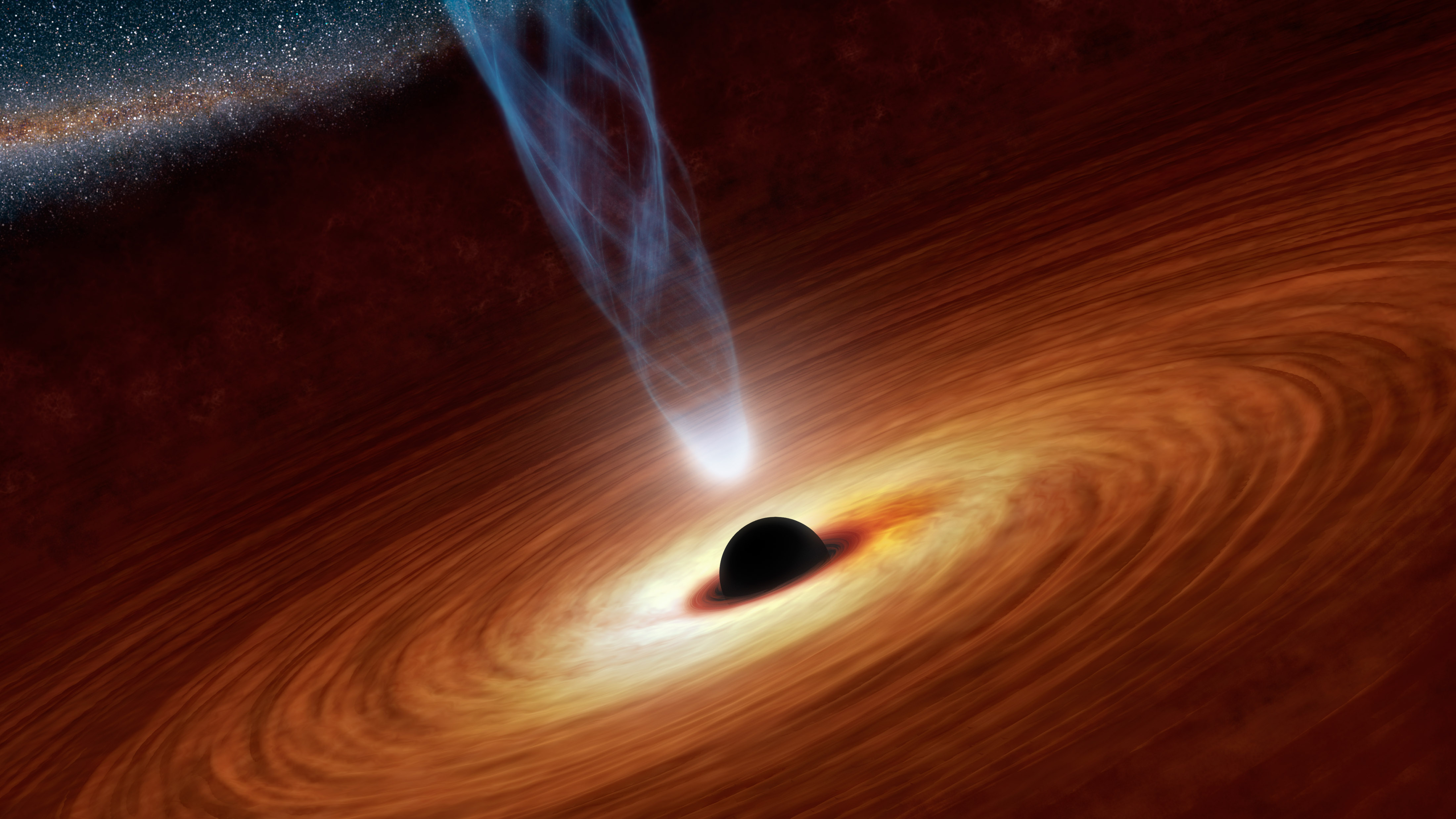
a) Black holes are out of our Solar System. They are formed when massive stars collapse under their own gravity. These stars collapse when their fuel is exhausted. Such stars may become a white dwarf or a neutron star.

b) Nuclear reactions in the core of the star produce enough energy and pressure to push it outward. However, when the fuel required for these reactions is exhausted, gravity pulls the star's outer surface to its core. In this position, the stars expand nearly to the Sun's size, cool down and become white dwarf.

c) However, for stars that are about 5 times the Sun's mass, the fusion process continues till the stars explode. Its outer parts are violently expelled into space, while the core wholly collapses under its own weight.

d) When this happens, it would require a velocity greater than the speed of light to escape the object's gravity. Since no object can reach a speed faster than light, no matter or radiation can escape the gravitational force. Anything, including light that passes within the boundary of the black hole called the "event horizon" is trapped forever.

f) If the remaining mass of the star is 1.4 times the Sun's mass, then the star is changed into white dwarf star (cold star). The maximum mass of a stable white dwarf star (1.39 M☉ or 1.39 solar mass) is called the Chandrasekhar limit. S. Chandrasekhar was an American astrophysicist of Indian origin who got the Nobel Prize in physics for the discovery of Chandrasekhar limit.


To get fresh updates about different exams on your Facebook & Twitter timelines, subscribe to our pages created specifically for them. We will post only exam specific links on these pages:


Bank PO:

Facebook: https://www.facebook.com/pagalguybankpo

Twitter: https://twitter.com/PaGaLGuYBankPO


SSC - CGL:

Facebook: http://www.pagalguy.com/ssc

Twitter: https://twitter.com/pagalguyssc


UPSC:

Facebook: https://www.facebook.com/pages/Pagalguy-UPSC/951926044840262

Twitter: https://twitter.com/PaGaLGuYUPSC

UPSC

My friend Raghav lost a great job opportunity because he was late for the interview & someone else bagged his dream job. This happened due to his inability to read maps on his GPS. He missed a few important signs and interpreted clues the wrong way. Sometimes we also might have had similar befuddling experiences when our equipment failed and left us at the mercy of our confused brain.

Why does this happen? The Royal Institute of Navigation of UK stated that increasing dependence on technology is an indication of people losing the ability to find directions using traditional methods. We no longer invest our time in map reading to sharpen our orienteering skills. Maps help us improve our special awareness. These skills are a part of our visual literacy that helps us to read images, understand symbols & imagine the locations of places.

For a SSC-UPSC aspirant, the Atlas is his/her picture dictionary. The Atlas provides us in-depth information about the physical orientation of the Earth, the political boundaries of countries, among others. Here are some important parts of our UPSC GK syllabus that require adequate map reading skills. 

Direct map questions like 'Name the country/river' or 'Match the columns'

Studying physical as well as human geography.

For example,

a) In physical geography, maps help us to understand topics like: ocean currents, mountains, rivers, vegetation, monsoon routes etc.

b) In human geography, maps help us to understand topics like: the network of roads, rail routes, capital cities, ports, mineral deposits etc.

c) The atlas is handy while studying international relations & diplomacy. Many new developments in the topic can be well understood when studied in picture form. 

For example, to get a proper idea of the Iran-China pipeline through CPEC region, having a map of the region handy is helpful. Similarly, to study the regional organisations, economic corridors, inter-continental sea-land trade routes, map are of great help.

d) Also, maps can be used to study India's political history, locations of archaeological excavations, ancient places like Mahajanpadas and wonders known for their architectural style.

e) While studying national policies and programmes, maps provide a broader idea of these events. For example, the Amrut project & Golden Quadrilateral highway network.

Though there are many benefits of map reading skills, students prefer not to refer Atlas to grasp the geographical information provided in words.  But in reality, building up these navigational skills certainly helps a lot. You will get a better understanding of places, patterns and events that will surely be of help even in the descriptive mains exam. As it is said, 'a picture is worth a thousand words.' Now, it's up to you to choose. A picture? Or thousand words?

standard textbooks(not including ncerts) for history optional ??

ancient?

medieval?

modern ?

and world ?


1. Western classical elements can be seen in the Gandhara School of Art as reflected in the Buddha’s
1. usina, urna and elongated ears.
2. head
3. heavy folds of the robe.
Select the correct answer using the codes given below.

  • b) 1 and 3 only
  • a) 1 and 2 only
  • c) 2 and 3 only
  • d) 1, 2 and 3

0 voters

1. The Kudumbashree program by the Kerala government works in the area of
1. reducing maternal mortality
2. providing micro credit
3. enhancing entrepreneurship
4. providing housing
Select the correct answer using the codes given below.

  • a) 1 and 2 only
  • c) 2 and 3 only
  • d) 1 ,2, and 4 only
  • b) 1 ,3 and 4 only

0 voters

Can someone please  describe the difference between Collegium system and National Judicial Appointments Commission ? Please enunciate........

Dear Readers,

Current affairs forms an important component of several competitive exams such as the UPSC Civil Services Examination, SSC CGL, Bank PO and PSU entrance tests, etc. Therefore, understanding terms/concepts/events that are in the news is critical for aspirants. We at PaGaLGuY bring you this series of articles explaining some of these important concepts/events in detail.

In this article we are discussing our Earth.

Earth is a unique planet in the solar system because of presence of life. It is because the Earth has the presence of water and biosphere. 

Shape of the Earth:

a) The shape of the Earth is close to a geoid or oblate spheroid.  It is so because the Earth is bulging at the equator and flat on the poles.

b) The Earth's equatorial circumference is 24,897 miles. However, the circumference at the polar region is 83 miles less than that of the equilateral circumference due to the flat structure at the polar region.

c) The bulge at the equator is produced by the centrifugal force acting on the rotating Earth. 

d) The gravitation force at the equator is minimum whereas it is maximum at the poles.

e) Earth's equator is a virtual line dividing the Earth's sphere into two equal, horizontal parts. The line that goes through the core of Earth and joins the North and South Pole is called the Geographical Axis.

Earth's movements :

a) The Earth moves in two distinct ways. It rotates on its own axis from west to east (anti-clockwise) every 24 hours causing day and night. It also revolves around the Sun in an elliptical orbit once in every 365 ¼ days causing change in the year and the seasons.

b) Earth spins around the Sun at a speed of 18.5 miles per second. 

c) The axis of the Earth is inclined towards the Sun at an angle of 66 ½ degrees thereby resulting in change in seasons and variations in lengths of days and nights. In winter season, if we go northward, the hours steadily increase.  At the North Pole, half the year is dark. During mid-winter, on December 22, it is dark the whole day.

d) During summer, the conditions get reversed. Thus, at the North Pole the Sun never sets on June 21 and there is six months of continuous daylight.

e) In the southern hemisphere the same conditions occur, but exactly reversed. 

The midday Sun:

a) Due to Earth's inclined axis, the Sun is vertically overhead at the equator on two days every year. These are usually March 21 or September 21.  These two days are termed as equinoxes i.e. equal night and day. 

b) After the March equinox, the Sun appears to move north and is vertically overhead at the Tropic of Cancer on June 21. This is known as June or summer solstice. On this day, the northern hemisphere experiences longest day and shortest night.

c) After the September equinox, the Sun appears to move south and is vertically overhead at Tropic of Capricorn on December 22. This is known as winter solstice. On this day, the northern hemisphere experience shortest day and longest night.

d) During summer, the Sun is higher in the sky than in winter. Due to this, its rays fall on Earth vertically, the heat concentrated on a small area. Hence, summers are hot.

e) During winter, the oblique rays of Sun come through less directly and much of the heat is absorbed by the atmosphere. Also, they spread over bigger area thereby making winters cold.


To get fresh updates about different exams on your Facebook & Twitter timelines, subscribe to our pages created specifically for them. We will post only exam specific links on these pages:


Bank PO:

Facebook: https://www.facebook.com/pagalguybankpo

Twitter: https://twitter.com/PaGaLGuYBankPO


SSC - CGL:

Facebook: http://www.pagalguy.com/ssc

Twitter: https://twitter.com/pagalguyssc


UPSC:

Facebook: https://www.facebook.com/pages/Pagalguy-UPSC/951926044840262

Twitter: https://twitter.com/PaGaLGuYUPSC

General


Dear Readers,

General Knowledge is important for most competitive exams, namely the UPSC Civil Services Examination, SSC CGL, Bank PO & PSU entrance tests, etc. Therefore, an understanding of the concepts/terms that are significant in our daily lives is critical for aspirants. To make your preparation easier and to help you score better, we at PaGaLGuY bring you brief articles on trending phenomena and concepts.


In the previous article, we discussed the basics of cancer. This article will explain different types of cancers and its examples.

Types of Cancers

Cancer is not a single disease but a complex of many diseases. More than 200 distinct types of cancers have been recognised. These can be grouped into four major categories:


1. Carcinoma: It is the type of cancer that develops from epithelial cells (outermost skin cells) or the outer lining of organs. Malignant in nature, carcinomas affect breast, lung, prostate and colon and are most common in adults. About 85% of cancers in humans are carcinomas.


2. Leukaemia: Commonly known as blood cancer, this type involves abnormally high production of neoplastic leucocytes/ white blood cells (WBCs). It affects the bone marrow and spreads to other parts like spleen, liver, brain and spinal cord. Most common form of childhood cancers, it accounts for only 3 - 4% of cancers in humans.


3. Sarcoma: rare type of cancer, sarcoma develops in the connective tissue cells (cells that connect or support other tissues in the body). They are solid tumors growing from bones, cartilage, tendons, nerves and muscles. Relatively rare in humans, it accounts for only 1 - 2% of cancers in humans.


4. Lymphoma: It is a cancer of the lymph system causing abnormal production of lymphocytes (cells of the immune system). It affects the lymph nodes, spleen, thymus and other parts of the body. Hodgkin's disease is a type of lymphoma. Most commonly found in young people, lymphomas constitute about 5% of human cancers.


To get fresh updates about different exams on your Facebook & Twitter timelines, subscribe to our pages created specifically for them. We will post only exam specific links on these pages:

Bank PO:

Facebook: https://www.facebook.com/pagalguybankpo

Twitter: https://twitter.com/PaGaLGuYBankPO

SSC - CGL:

Facebook: http://www.pagalguy.com/ssc

Twitter: https://twitter.com/pagalguyssc


UPSC:

Facebook: https://www.facebook.com/pages/Pagalguy-UPSC/951926044840262

Twitter: https://twitter.com/PaGaLGuYUPSC

Dear Readers,

Current affairs is an important component of several competitive exams such as the UPSC Civil Services Examination, SSC CGL, Bank PO & PSU entrance tests, etc. Therefore, understanding the terms/concepts/events that make news is critical for aspirants.

New initiatives and socio- economic policies or what are known as flagship programmes announced by the Union Government are often asked in competitive examinations. Therefore, to help you deepen your understanding of the same, we at PaGaLGuY bring you information on such initiatives announced by the Government of India.

In today's article, we will look at some of the highlights of the Government's 'Make in India' initiative. 

Background: 

The 'Make in India' initiative is Prime Minister Modi's signature effort to attract both foreign and Indian companies to invest in India. The Make in India programme was presented by the PM in his Independence Day speech in 2014 and launched on 25th September 2014 at both, national and state level. It is implemented by the Department of Industrial Policy and Promotion, Ministry of Commerce and Industry. 

Some key features of the initiative: 

* The Union Government along with the state governments and the Federation of Indian Chambers of Commerce and Industry (FICCI), has instituted a body - Invest India - to guide foreign investors on regulatory and policy issues.

* E-Biz portal, a 24x7, real-time platform has been set up for all central and state-level regulatory clearances.

* A dedicated cell will be set up to revamp query-handling process. An exhaustive list of FAQs will help investors find answers within 48-72 hours. 

* A proactive approach would be adopted to track visitors' geographical location, interest and real-time user behaviour.  Subsequent visits will be customised for the user based on the information collected. Registered visitors will be sent relevant information and newsletters to clarify queries.

*Investor facilitation cell will assist investors from the time of travel till their departure. The campaign will also target top companies in identified countries and sectors.

* The initiative will identify Indian companies leading in innovation and new technology and turn them into a global champions. The aim will be to promote green and advanced manufacturing and help these companies be a part of the global value chain. 

*The government has identified several sectors to attract investment, enhance GDP growth and tax revenue: automobiles, chemicals, IT, pharmaceuticals, textiles, ports, aviation, leather, tourism and hospitality, wellness, railways, auto components, design manufacturing, renewable energy, mining, bio-technology, and electronics.


To learn about other GoI initiatives click here:

(a) AMRUT and Smart cities -

http://www.pagalguy.com/articles/amrut-and-smart-cities-missions-important-initiatives-by-the-345423...

(b) Swacch Bharat Mission -

http://www.pagalguy.com/articles/swachh-bharat-mission-new-initiatives-by-the-government-34578549

(c) Digital India Intiative -

http://www.pagalguy.com/articles/important-initiatives-by-the-government-digital-india-34772337

(d) Beti Bachao Beti Padhao -

http://www.pagalguy.com/articles/government-of-india-initiatives-beti-bachao-beti-padhao-abhi-347902...

To follow our UPSC portal on Facebook and Twitter, click on the following links:

Bank PO:

Facebook:https://www.facebook.com/pagalguybankpo

Twitter:https://twitter.com/PaGaLGuYBankPO

SSC - CGL:

Facebook:https://www.facebook.com/pages/Pagalguy-SSC-CGL-Others/879667042056262

Twitter:https://twitter.com/pagalguyssc

UPSC:

Facebook:https://www.facebook.com/pages/Pagalguy-UPSC/951926044840262

Twitter:https://twitter.com/PaGaLGuYUPSC

General

Dear Readers,

General Knowledge is important for most competitive exams, namely the UPSC Civil Services Examination, SSC CGL, Bank PO & PSU entrance tests, etc. Therefore, an understanding of the concepts/terms that are significant in our daily lives is critical for aspirants. To make your preparation easier and to help you score better, we at PaGaLGuY bring you brief articles on trending phenomena and concepts.


Current developments regarding cancers:

1. Supreme Court rejected international pharmaceutical company, Bayer's appeal to stop Hyderabad-based counterpart Natco from producing a generic version of Bayer's patented drug for kidney cancer (named Nexavar). This decision has increased availability and accessibility of cheaper versions of cancer drugs against its expensive counterparts.


2. Journal of Science by scientists at the Sidney Kimmel Cancer Centre at the Johns Hopkins University School of Medicine says that 'only a third of the variation in cancer risk among tissues is attributable to environmental factors or inherited predispositions and that the majority is due to 'bad luck,' i.e. random mutations arising during DNA replication of normal, non-cancerous stem cells." Cancer is thus a multifactorial disease that depends on many factors. It is not essentially due to hereditary factors and chance mutations.


3. A potential drug to treat cancer- 6-thio-2'-deoxyguanosine (6-thiodG) - has been developed at the University of Texas Southwestern Medical Centre in the US. It is a molecule that can stop growth of cancer cells by resetting their biological clock. When tested on telomeres (distinctive structures found at the end of the DNA strand) these compounds caused the tumour cells to shrink. This could be a great alternative to treatment methods like surgery and chemotherapy.


4. WHO predicts cancer death rates to rise by 70% in the next 20 years as death of cancer patients is increasing every year. WHO stresses on vaccination against Human Papilloma virus (HPV), Hepatitis-B and reduced exposure to non-ionized sunlight radiation. This is said to result in a 25 per cent drop in deaths due to non-communicable diseases by 2025.


To get fresh updates about different exams on your Facebook & Twitter timelines, subscribe to our pages created specifically for them. We will post only exam specific links on these pages:

Bank PO:

Facebook: https://www.facebook.com/pagalguybankpo

Twitter: https://twitter.com/PaGaLGuYBankPO

SSC - CGL:

Facebook: http://www.pagalguy.com/ssc

Twitter: https://twitter.com/pagalguyssc

UPSC:

Facebook: https://www.facebook.com/pages/Pagalguy-UPSC/951926044840262

Twitter: https://twitter.com/PaGaLGuYUPSC


Dear Readers,

Current affairs is an important component of several competitive exams such as the UPSC Civil Services Examination, SSC CGL, Bank PO & PSU entrance tests, etc. Therefore, understanding the terms/concepts/events that make news is critical for aspirants. We at PaGaLGuY bring you series of articles explaining some of these important concepts/events.

In this article we are discussing our Earth's Latitude & Longitude.

Locations of places on Earth:

To easily calculate exact locations of places on the Earth, imaginary lines have been drawn.

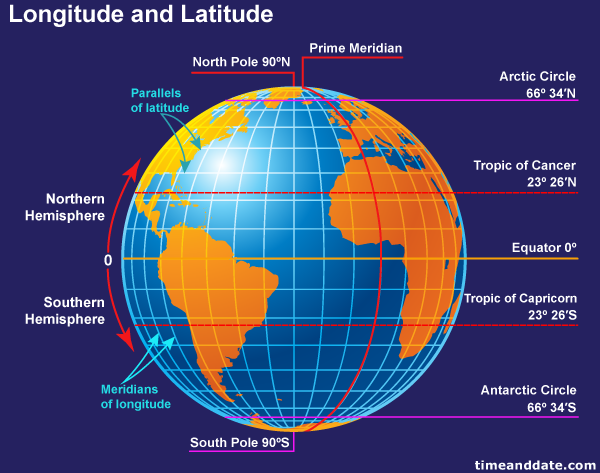
The horizontal lines from east to west that are parallel to the equator are called lines of latitude. The vertical lines from north to south are called lines of longitude. The point where these lines intersect denotes the location of any particular place on Earth.

Latitude:

a) Latitude specifies the north-south position of a point on the Earth. Their position are determined with respect to the equator. The equator represents 0 degrees whereas South and North Poles are 90° S & 90° N respectively.

b) The lines of latitude are drawn at intervals of 1°. For a more precise location, each degree is divided into 60 minutes & each minute into 60 seconds. 

c) The most important lines of latitude are equator (0°), Tropic of Cancer (23 ½ °N), Tropic of Capricorn (23 ½ °S), the Arctic Circle (66 ½ °N) & the Antarctic Circle (66 ½ ° S).

d) The equator is called the great circle. 

e) The degree of the altitude is little longer on the poles as the poles are flatter than the equator.

f) The Tropic of Cancer divides India into almost two equal parts by passing through 8 states, namely- Gujarat, Rajasthan, Madhya Pradesh, Chhattisgarh, Jharkhand, West Bengal, Tripura & Mizoram.

Longitude:

a) The longitude is an angular distance measured in degrees with respect to the prime meridian. 

b) In 1884, the meridian that passes through the Royal Astronomical Observatory at Greenwich near London was chosen as the zero meridian or prime meridian by an international agreement. 

c) All other meridians radiate eastwards and westwards from the prime meridian up to 180°. The linear distance between any two longitudes is of 1°. There are in total 360 longitudes on the Earth's surface.

d) The degree of longitude is longest at the equator and shortest at the poles.

e) The prime meridian at Greenwich is very important to calculate the local time anywhere in the world with respect to G.M.T. or Greenwich Mean Time, also referred to as world time.

f) Africa is the only continent that is intersected by the prime meridian, equator, Tropic of Cancer & Tropic of Capricorn. 

g) Antipode is a point opposite to any given point on the Earth's surface.

Consider, if it is daytime at point X on the Earth, then it is night at its antipode. Also the length of the day at point X is equal to the length of the night at its antipode. So, there is a 12-hour difference between these two points.

Note : Students should study atlas to get a general idea of the countries located on the equator, Tropic of Cancer, Tropic of Capricorn , On 66 ½ ° latitude in Arctic region. 


To get fresh updates about different exams on your Facebook & Twitter timelines, subscribe to our pages created specifically for them. We will post only exam specific links on these pages:

Bank PO:

Facebook: https://www.facebook.com/pagalguybankpo

Twitter: https://twitter.com/PaGaLGuYBankPO

SSC - CGL:

Facebook: http://www.pagalguy.com/ssc

Twitter: https://twitter.com/pagalguyssc

UPSC:

Facebook: https://www.facebook.com/pages/Pagalguy-UPSC/951926044840262

Twitter: https://twitter.com/PaGaLGuYUPSC

Dear Readers,

Current affairs forms an important component of several competitive exams such as the UPSC Civil Services Examination, SSC CGL, Bank PO & PSU entrance tests, etc. Therefore, understanding terms/concepts/events that are in the news is critical for aspirants. We at PaGaLGuY bring you this series of articles in which we shall explain some of these important concepts/events for you.

In this article we are discussing Our Earth & Moon.

Local Time: 
UPSC

a) As we know Earth takes 24 hours to complete the revolution in 360°, it passes through 15° in one hour and 1° in every 4 minutes.

b) We use G.M.T. as a reference to determine the local timing of any place on the surface of earth. 

c) There are total 24 time zones in the whole world. Each time zone is of 15°. Russia is the largest country which extends through 165° of longitude divided in eleven time zones. 

d) Indian Standard Time is calculated on the basis of 82.5° E longitude in Mirzapur ,Uttar Pradesh) which is nearly on the corresponding longitude reference line. The IST is 5.30 hours ahead of GMT.

e) Time difference between eastern and western extremes in India is of two hours.

International Date Line:

a) If we travel towards the east direction from Greenwich line until we reach 180°E, we will be 12 hrs ahead of GMT. Similarly if we travel westward to 180°W, we will be 12 hrs behind from GMT.

b) There is a difference of a whole day between two sides of 180° meridian. This meridian is called as an International Date Line. If this line is crossed from Eastern side to the western side, we lose a whole day. Similarly, if we cross this line from western side to the eastern side, we end up in losing a whole day.

c) This line passes through Bering Strait in Pacific Ocean. 

Moon :

a) Moon is the only satellite of Earth revolving around her in an elliptical orbit. Moon revolves around the earth as well rotates around the sun. 

b) When moon is at apogee, it is farthest from the Earth. When its at perigee, it is closest from the Earth.

c) The sidereal period of moon is the time required by moon with respect to some fixed stars. The sidereal period of moon is 27.3 days if observed from earth.

d) The synodical period of moon is the time required by moon with respect to sun. The synodical period of moon is 29.5 days. It is considered as a Lunar month.

e) The effect of gravity on moon is only 17% to the gravity on surface of Earth.

f) The USA's NASA Apollo 11 mission in 1969 was the first manned Moon landing. 

g) The surface of the Moon features a huge number of impact craters from comets and asteroids that have collided with the surface over time. Because the Moon lacks an atmosphere or weather these craters remain well preserved.

h) A lunar eclipse occurs when the Earth is between the Sun and the Moon. 

i) The Earth's tides are largely caused by the gravitational pull of the Moon.


To get fresh updates about different exams on your Facebook & Twitter timelines, subscribe to our pages created specifically for them. We will post only exam specific links on these pages:

Bank PO:

Facebook: https://www.facebook.com/pagalguybankpo

Twitter: https://twitter.com/PaGaLGuYBankPO

SSC - CGL:

Facebook: http://www.pagalguy.com/ssc

Twitter: https://twitter.com/pagalguyssc

UPSC:

Facebook: https://www.facebook.com/pages/Pagalguy-UPSC/951926044840262

Twitter: https://twitter.com/PaGaLGuYUPSC
Upsc prelims marks declared

Dear Readers,

Current affairs is an important component of several competitive exams such as the UPSC Civil Services Examination, SSC CGL, Bank PO & PSU entrance tests, etc. Therefore, understanding the terms/concepts/events that make news is critical for aspirants. We at PaGaLGuY bring you series of articles explaining some of these important concepts/events.

In this article we are discussing our Earth.

Composition of Earth:

Earth was formed almost around 4500 million years ago.

Earth's crust is made up of the following elements:

Iron (Fe)                  32%

Oxygen (O)              30%

Silicon (Si)               15%

Magnesium (Mg)       14%

Nickel (Ni)                2%

The trace amount of calcium, aluminium & other elements are also present in Earth's crust.

The structure of Earth:

UPSC

a) The structure of Earth is determined by seismic waves inside the Earth. 

b) When rock masses move deep within the Earth, energy in the form of seismic waves moves outward through the rock from the point of origin-called the focus. The initial movement occurs at the focus.

c) The epicenter is the point on the surface directly above the focus. From epicenter, seismic waves radiate in all directions on surface of the Earth.

Here are two different types of waves:

Body waves: These waves moves into internal layers of the Earth. Body waves are further divided into 2 parts:

The S waves help scientists to understand the interior of the Earth.

Surface waves: These waves move in the surface of Earth. These waves are responsible for creating vibration and shakes on the Earth's surface. 

The S waves help scientists to understand the interior of the Earth.

Surface waves: These waves move in the surface of Earth. These waves are responsible for creating vibration and shakes on the Earth's surface. 


To get fresh updates about different exams on your Facebook & Twitter timelines, subscribe to our pages created specifically for them. We will post only exam specific links on these pages:

Bank PO:

Facebook: https://www.facebook.com/pagalguybankpo

Twitter: https://twitter.com/PaGaLGuYBankPO

SSC - CGL:

Facebook: http://www.pagalguy.com/ssc

Twitter: https://twitter.com/pagalguyssc

UPSC:

Facebook: https://www.facebook.com/pages/Pagalguy-UPSC/951926044840262

Twitter: https://twitter.com/PaGaLGuYUPSC

Please fill the form:

http://goo.gl/forms/J7OMqIa2Mp

Responses can be viewed here:
https://docs.google.com/spreadsheets/d/1oj9FBke2uUlhx92EmZOMrkeKS2-e9fEh4TR8x3pUxfs/edit#gid=1817295...

One response per login.
Login is required, but email id is protected.

Pre and Mains marks are out...


Is there any way to get Roll no. I lost mine[UPSC 2014]

Frnds although official cutoff are not declared by upsc ,will be declared in a day or two,      

Following is the cutoff for prelim according to marks revcealed by my frnd circle some of whome wualified and some not..

Genral-205

Obc-204

Sc-181

St- 165-170 not sure

As CSAT paper 2 is only qualifying now, what whould b a good score in paper 1 to clear prilims? Any idea friends ? Provide any link if u come across such prediction.

So friends who are all score the cutoff marks in gs with 33% in paper2 ll be eligible for mains 2015 na???