According to the Webster Dictionary, the definition of science is “knowledge attained through study or practice,” or "knowledge covering general truths of the operation of general laws, esp. as obtained and tested through scientific method [and] c…
According to the Webster Dictionary, the definition of science is "knowledge attained through study or practice," or "knowledge covering general truths of the operation of general laws, esp. as obtained and tested through scientific method [and] concerned with the physical world."
When I hear that Sales is a science that can be explored and studied as theoritically as quantum physics or organic chemistry, I find it hard to believe.
As a student who had studied science (physics, chemistry, biology) as subjects and has been seeing the growth of scientific boundaries since then, it is hard to connect the two in the way people perceive it to be.
Through the hypothesis, the various laws that govern various scientific explorations and constant values which balance many equations, we understand that science is dependant on certain variables and those behave in certain ways to maintain some kind of equilibrium and status-quo. Even evolution or theory of Relativity of Prof Einstein are governed by rules.
So what am I saying here? I am pointing out to sales personnels that in case you feel sales is a science, then you should know that there are rules, basic theories, dimensions that govern sales at the end of the day.
The other day I got to know about a mathematical model of terrorist attacks and that it is now possible to predict the next dates for an attack it seems (although accuracy claimed is yet to be ascertained).
Can we develop a similar model for sales? Or can we for once come to a consensus that more than mere experiential learning, sales can be figured out through models, theories, and statistical data?
Most sales professionals will gape and say "how in the world can this be termed as a science?". Old school thinkers do believe that this functional area can be learnt through experience and that in most cases, a rule cannot define the ways a Sale is actually made. How does one account for the finer details like a lunch/dinner meeting closures or various anchor points that is only figured out during meetings that a sales rep has throughout his lifetime? How does one account for things like empathizing and negotiating to the correct price points and then closing sale?
While I have had internal debates in my mind on this very aspect, I cannot but wish away the Behavioral sciences that govern many of my interactions with my leads. I cannot but wish away the fact that statistical data about revenue spending on a particular service providing domain influences a lot of decisions that my client takes at the end of the day. I always look at ensuring that data driven conclusions are made about the way we would approach a particular client. In case of no data, we take the best possible case in mind for that client and then support it with a Plan B or Plan C. This again will be logical deductions that are in place.
I guess one of the most important factor that we overlook while we think of sales is that we forget sales as a function has to evolve. We need to be a part of that process to evolve. To do this, we need to be aware of what govern our sales universe. We need to understand that in this universe, there exists rules that mirror many laws of physics. Something like "Behavior is always caused" mirrors "For every action there is an equal or opposite reaction". I am aware that for every action of mine, I trigger a behavior in my client that will either be a response towards closure of the deal or losing the client altogether.
Now it is not always that we get to think this much before a client meeting and then go ahead for a meeting or speak to the client or answer his questions. It is very difficult to believe that these rules can be used properly in real-time within the next week itself.
But didnt we perfect our knowledge about "Pressure in inversely proportional to Volume" through our experiments that we used to do in our labs at school? Similarly, I can perfect the use of the rules and laws of sales through experiments that can be done internally at my workplace. I can do it as a culture change amongst my colleagues. I can probably do it alone and read up or research on these experiments.
To do great sales, it is pertinent that I master the rules and laws first rather than to be focussed to make that next Million Dollar sale. At times it never comes or comes very late. More often than not, we realize later that we wasted a lot of our productive time in sales chasing nothing. We can actually do better.
I would want to work with my team in these lines. I would want to create the next generation of sales reps who respect this function like a science. And know for a fact that they are scientists themselves who can uncover the hidden potentials that sales has in place. These would be the guys who will write the next set of books in sales best practices, but they will actually end up sharing the rules and laws that govern out universe of sales.
When I hear that Sales is a science that can be explored and studied as theoritically as quantum physics or organic chemistry, I find it hard to believe.
As a student who had studied science (physics, chemistry, biology) as subjects and has been seeing the growth of scientific boundaries since then, it is hard to connect the two in the way people perceive it to be.
Through the hypothesis, the various laws that govern various scientific explorations and constant values which balance many equations, we understand that science is dependant on certain variables and those behave in certain ways to maintain some kind of equilibrium and status-quo. Even evolution or theory of Relativity of Prof Einstein are governed by rules.
So what am I saying here? I am pointing out to sales personnels that in case you feel sales is a science, then you should know that there are rules, basic theories, dimensions that govern sales at the end of the day.
The other day I got to know about a mathematical model of terrorist attacks and that it is now possible to predict the next dates for an attack it seems (although accuracy claimed is yet to be ascertained).
Can we develop a similar model for sales? Or can we for once come to a consensus that more than mere experiential learning, sales can be figured out through models, theories, and statistical data?
Most sales professionals will gape and say "how in the world can this be termed as a science?". Old school thinkers do believe that this functional area can be learnt through experience and that in most cases, a rule cannot define the ways a Sale is actually made. How does one account for the finer details like a lunch/dinner meeting closures or various anchor points that is only figured out during meetings that a sales rep has throughout his lifetime? How does one account for things like empathizing and negotiating to the correct price points and then closing sale?
While I have had internal debates in my mind on this very aspect, I cannot but wish away the Behavioral sciences that govern many of my interactions with my leads. I cannot but wish away the fact that statistical data about revenue spending on a particular service providing domain influences a lot of decisions that my client takes at the end of the day. I always look at ensuring that data driven conclusions are made about the way we would approach a particular client. In case of no data, we take the best possible case in mind for that client and then support it with a Plan B or Plan C. This again will be logical deductions that are in place.
I guess one of the most important factor that we overlook while we think of sales is that we forget sales as a function has to evolve. We need to be a part of that process to evolve. To do this, we need to be aware of what govern our sales universe. We need to understand that in this universe, there exists rules that mirror many laws of physics. Something like "Behavior is always caused" mirrors "For every action there is an equal or opposite reaction". I am aware that for every action of mine, I trigger a behavior in my client that will either be a response towards closure of the deal or losing the client altogether.
Now it is not always that we get to think this much before a client meeting and then go ahead for a meeting or speak to the client or answer his questions. It is very difficult to believe that these rules can be used properly in real-time within the next week itself.
But didnt we perfect our knowledge about "Pressure in inversely proportional to Volume" through our experiments that we used to do in our labs at school? Similarly, I can perfect the use of the rules and laws of sales through experiments that can be done internally at my workplace. I can do it as a culture change amongst my colleagues. I can probably do it alone and read up or research on these experiments.
To do great sales, it is pertinent that I master the rules and laws first rather than to be focussed to make that next Million Dollar sale. At times it never comes or comes very late. More often than not, we realize later that we wasted a lot of our productive time in sales chasing nothing. We can actually do better.
I would want to work with my team in these lines. I would want to create the next generation of sales reps who respect this function like a science. And know for a fact that they are scientists themselves who can uncover the hidden potentials that sales has in place. These would be the guys who will write the next set of books in sales best practices, but they will actually end up sharing the rules and laws that govern out universe of sales.
I came across this formula known as the Sales benchmarking index, which is:
Activity x Conversion Rate x Deal Size x Talent nos x Time = Total Revenues.
I guess these are the najor inputs in the sales process and most of us are aware of these indicators. The questions is - whether one can actually put statistically valid numbers per sales rep for each of these factors.
Measuring the conversion rate is easy, but do we consider if all the clients who came through a sales rep were of different characteristics and probably geographies? What about needs and the right time? The variable "TIME" in this formula is a constant 240-260 days work-days that a sales rep will have across the year. The issue is that the "conversion rate" thus used for this calculation will have to be a mean value of the peak season and the lean season. How else would one support the fact that even the best sales guys work according to the schedule or time-table of the customers and things cannot be pushed through these days. People can write you off in forums anytime and anywhere
My take in a formula like this is - tread with caution while you may embrace such mathematical deductions for Sales as a function. I will work on a few iterations on the same formula myself and figure out if there are possibilities that can be added on during the experiments.
Activity x Conversion Rate x Deal Size x Talent nos x Time = Total Revenues.
I guess these are the najor inputs in the sales process and most of us are aware of these indicators. The questions is - whether one can actually put statistically valid numbers per sales rep for each of these factors.
Measuring the conversion rate is easy, but do we consider if all the clients who came through a sales rep were of different characteristics and probably geographies? What about needs and the right time? The variable "TIME" in this formula is a constant 240-260 days work-days that a sales rep will have across the year. The issue is that the "conversion rate" thus used for this calculation will have to be a mean value of the peak season and the lean season. How else would one support the fact that even the best sales guys work according to the schedule or time-table of the customers and things cannot be pushed through these days. People can write you off in forums anytime and anywhere
My take in a formula like this is - tread with caution while you may embrace such mathematical deductions for Sales as a function. I will work on a few iterations on the same formula myself and figure out if there are possibilities that can be added on during the experiments.
I have mention both the words in relation to the Sales process.
Followups as we all know is an important part of the sales process but at most times this is neglected and somehow no one knows to figure out "How much followup is good followup?".
I know for a fact that if I dont followup regularly with my prospective clients then all the "hot" leads will trun "cold" in no time. Then I face the prospect of facing a cilent who blames the delays on my lack of "proactiveness". I hurt the prospect of a confirmed sale and also repeat sales from the same guy.
Given that today's sales is complex and in almost every occassion I am dealing with more than one individual in an organization while I am trying to close the deal, it is pertinent to understand the importance of followup calls and schedule them accordingly so that we can get the desired results. It does not take much of a reps time to design the schedule and also understand a good time of the day to do the followup calls. I can be great at my strategy pre-sales and also great communicator to sell the idea but if I miss the important time-lines in followup then I miss the deal as well.
Follow-through involves sales guys to think through in terms of the procedural changes or sudden "U-turns" that may happen in the course of the deal. There are times when a large market is given to a rep and all he does is gors ahead without taking into consideration the twists and turns that may come across his way from so many different clients. The idea here is to learn as you sell through and think of more innovative ways of presenting an idea to the clients. It is a daily learning process. You have to go there and provide the same client a new perspective and maybe that will help you in closing the deal faster than anyone else. I want to do the same and will want to work with sales reps who can follow this. I want to think on the different ways I can make a difference to my existing products by providing a selling-mix to the client and ensure that this learning is then re-engaged in a better way while I am back home thinking of my next level of strategies for the next set of clients.
I dont always need my boss to think something for me. thats something I will want my team-mate to have with whom I will work my next 20 years to churn out excellent results. The idea of using innovative ways is not limited to products or design - it is also applicable largely to sales and is required daily.
Followups are boring and at times it can be frustrating, but it inescapable if you want to be doing great sales. Follow-throughs, similarly, are required in every step of my sales wherein I am going to use them to design the next set of deliverables that will be unmatched by any of my competitors as these mixes will be based on real-time market intelligence gathered by me and then validated by my experiences.
Followups as we all know is an important part of the sales process but at most times this is neglected and somehow no one knows to figure out "How much followup is good followup?".
I know for a fact that if I dont followup regularly with my prospective clients then all the "hot" leads will trun "cold" in no time. Then I face the prospect of facing a cilent who blames the delays on my lack of "proactiveness". I hurt the prospect of a confirmed sale and also repeat sales from the same guy.
Given that today's sales is complex and in almost every occassion I am dealing with more than one individual in an organization while I am trying to close the deal, it is pertinent to understand the importance of followup calls and schedule them accordingly so that we can get the desired results. It does not take much of a reps time to design the schedule and also understand a good time of the day to do the followup calls. I can be great at my strategy pre-sales and also great communicator to sell the idea but if I miss the important time-lines in followup then I miss the deal as well.
Follow-through involves sales guys to think through in terms of the procedural changes or sudden "U-turns" that may happen in the course of the deal. There are times when a large market is given to a rep and all he does is gors ahead without taking into consideration the twists and turns that may come across his way from so many different clients. The idea here is to learn as you sell through and think of more innovative ways of presenting an idea to the clients. It is a daily learning process. You have to go there and provide the same client a new perspective and maybe that will help you in closing the deal faster than anyone else. I want to do the same and will want to work with sales reps who can follow this. I want to think on the different ways I can make a difference to my existing products by providing a selling-mix to the client and ensure that this learning is then re-engaged in a better way while I am back home thinking of my next level of strategies for the next set of clients.
I dont always need my boss to think something for me. thats something I will want my team-mate to have with whom I will work my next 20 years to churn out excellent results. The idea of using innovative ways is not limited to products or design - it is also applicable largely to sales and is required daily.
Followups are boring and at times it can be frustrating, but it inescapable if you want to be doing great sales. Follow-throughs, similarly, are required in every step of my sales wherein I am going to use them to design the next set of deliverables that will be unmatched by any of my competitors as these mixes will be based on real-time market intelligence gathered by me and then validated by my experiences.
As a part of my daily self-analysis, I try to figure out why, at times, certian sure shot deals fall apart even if I had lunch/dinner with the most powerful person (read - the Director) of a Business School.
Knowing the people who have the "gold" with them is of utmost importance for many sales guys. I mean if you know the Top guy, you would order for a Champagne for yourself in advance for a deal. But ask me. Thats the biggest possible mistake a sales rep can make when selling to bschools.
The golden rule doesnt count here as there will be some person - internal or external, who will actually be responsible for helping the Diro make that final decision. An example here - few months back, one of my colleagues was followng up with this excellent bschool from Chennai in India and he had met every possible person including the student bodies and given presentations, written detailed emails, etc. Surprisingly as he was fighting for a deal worth Rs.300,000, another colleague of mine was contacted by the institute's ad agency and we got a deal worth Rs.800,000. what my dear colleague 1 missed out was the outside agency that had the maximum influence on the final decision.
We constantly have to look for those people in the entire circle who will be influencers and will have certain degree of veto power to say "yes" or "no" to our carefully made proposals.
In most cases, these Diros have an inner circle of people who have knowhow in certain areas that are not complete. But as a sales rep you will have to ensure that these people are as involved in the process as the Top guy. Treat their queries and everything else the way you will do for the Top guy but use common sense to understand the level of influence they will have on the final decisions.
Knowing the people who have the "gold" with them is of utmost importance for many sales guys. I mean if you know the Top guy, you would order for a Champagne for yourself in advance for a deal. But ask me. Thats the biggest possible mistake a sales rep can make when selling to bschools.
The golden rule doesnt count here as there will be some person - internal or external, who will actually be responsible for helping the Diro make that final decision. An example here - few months back, one of my colleagues was followng up with this excellent bschool from Chennai in India and he had met every possible person including the student bodies and given presentations, written detailed emails, etc. Surprisingly as he was fighting for a deal worth Rs.300,000, another colleague of mine was contacted by the institute's ad agency and we got a deal worth Rs.800,000. what my dear colleague 1 missed out was the outside agency that had the maximum influence on the final decision.
We constantly have to look for those people in the entire circle who will be influencers and will have certain degree of veto power to say "yes" or "no" to our carefully made proposals.
In most cases, these Diros have an inner circle of people who have knowhow in certain areas that are not complete. But as a sales rep you will have to ensure that these people are as involved in the process as the Top guy. Treat their queries and everything else the way you will do for the Top guy but use common sense to understand the level of influence they will have on the final decisions.
I would like to compare Sales to Kung-fu - the martial art form from China. You can learn about it in a few days/weeks, but you spend a lifetime to perfect it through practice.
As a sales practitioner, I regularly face the trouble of interacting with other sales-guys (as we all know them) for business, recruitment, etc.
It is sad that in India, the ways we think and act on sales function is pretty neolithic. Which means that usage of old methods is rampant and I guess most of it has come across generations of sales guys who have not had the environment or the challenges to do anything differently. For instance, it is predominantly still based on a person's personal qualities rather than a process driven or logic driven method. Most of the sales reps I meet try to showcase themselves as the divine-avatar who can sell anything under the Sun.
Organizations havent done anything good towards this as well. Whats the use? Sales people are expended bullets. As a CEO, I got someone to work his buttocks-off, drained everything out of that guy, and then let him drown under the sea of negligence. For many organizations, sales reps are like expended-bullets. Good when they hit targets, and useless after that.
Companies design variable pay structures to lure these sales reps onto commiting themselves to targets and then quickly push them into the cat-mouse chase. Forget about anything to do with nurturing the next revolutions in sales, or motivating these guys to look for answers to critical sales questions. For most part of their lives, these sales guys are always chasing numbers - thats it. "Arent we paying them bonuses for hitting those numbers? What else do you want me to do?" - screams a CEO. Sure the company does, but you pay extra-time for your Plumber or the Security guard as well. There should obviously be some difference for these sales reps who represent the organization in so many places and probably in so many different ways.
In most of the interviews that I have been taking for Sales, I have come across one major issue - absolute absence of any curiosity throughout their sales career and no past record of any drive to achieve more than their targets. The trouble with this set of people is that - the moment you give them an open chance to define what they can possible achieve, they will end up failing miserably. This will happen both in terms of setting what to achieve, and understanding the best ways possible currently to achieve them.
Reading sales books or books that attempt to explain sales, complex sales, and other tools of accelerating sales performance is not a bad idea. The problem with these books are that they define these interventions based on certain premises which again are based on trends in buying patterns and behaviors in certain companies, countries, continents, etc. Also, these excellent pieces of research is primarily based on external factors that will beg revision before blindly implementing them onto a sales team.
But again, these are literatures that will help a sales person with some curiosity and drive to know more about the ways sales has changed and how global buying behaviours are affecting the way we view sales as a function. Add onto this the challenges of creating excellent customer experiences, learning about the complex ways a sale is made today, and finally contributing fabulously to the top-line - you have a very tough job to do.
Which brings us to a few important questions:
Q. When will we find such sales personnel who will have the competence, drive and the curiosity to measure upto the challenges of today's global business networks.
Q. How will future sales teams look like and how will they function?
Q. How will we design compensation structures for these future sales reps?
Q. How will we figure out the progress of these sales reps without being intrusive?
Q. How will sales teams become an intrinsic part of an organization's strategic planning sessions?
It will need a lot of efforts to transform the next set of sales reps who will guide businesses to excellent top-line growths. I am not sure if it will mean a huge re-skilling exercise for the current batch of sales reps, but it sure needs a supernova kind of synergized effort from existing and new companies to maintain their competitive sales advantage. May be it will need another (Late) Prof C K Prahlad for Sales to pull this off - to create a religion in sales that will change the way we do sales today.
As a sales practitioner, I regularly face the trouble of interacting with other sales-guys (as we all know them) for business, recruitment, etc.
It is sad that in India, the ways we think and act on sales function is pretty neolithic. Which means that usage of old methods is rampant and I guess most of it has come across generations of sales guys who have not had the environment or the challenges to do anything differently. For instance, it is predominantly still based on a person's personal qualities rather than a process driven or logic driven method. Most of the sales reps I meet try to showcase themselves as the divine-avatar who can sell anything under the Sun.
Organizations havent done anything good towards this as well. Whats the use? Sales people are expended bullets. As a CEO, I got someone to work his buttocks-off, drained everything out of that guy, and then let him drown under the sea of negligence. For many organizations, sales reps are like expended-bullets. Good when they hit targets, and useless after that.
Companies design variable pay structures to lure these sales reps onto commiting themselves to targets and then quickly push them into the cat-mouse chase. Forget about anything to do with nurturing the next revolutions in sales, or motivating these guys to look for answers to critical sales questions. For most part of their lives, these sales guys are always chasing numbers - thats it. "Arent we paying them bonuses for hitting those numbers? What else do you want me to do?" - screams a CEO. Sure the company does, but you pay extra-time for your Plumber or the Security guard as well. There should obviously be some difference for these sales reps who represent the organization in so many places and probably in so many different ways.
In most of the interviews that I have been taking for Sales, I have come across one major issue - absolute absence of any curiosity throughout their sales career and no past record of any drive to achieve more than their targets. The trouble with this set of people is that - the moment you give them an open chance to define what they can possible achieve, they will end up failing miserably. This will happen both in terms of setting what to achieve, and understanding the best ways possible currently to achieve them.
Reading sales books or books that attempt to explain sales, complex sales, and other tools of accelerating sales performance is not a bad idea. The problem with these books are that they define these interventions based on certain premises which again are based on trends in buying patterns and behaviors in certain companies, countries, continents, etc. Also, these excellent pieces of research is primarily based on external factors that will beg revision before blindly implementing them onto a sales team.
But again, these are literatures that will help a sales person with some curiosity and drive to know more about the ways sales has changed and how global buying behaviours are affecting the way we view sales as a function. Add onto this the challenges of creating excellent customer experiences, learning about the complex ways a sale is made today, and finally contributing fabulously to the top-line - you have a very tough job to do.
Which brings us to a few important questions:
Q. When will we find such sales personnel who will have the competence, drive and the curiosity to measure upto the challenges of today's global business networks.
Q. How will future sales teams look like and how will they function?
Q. How will we design compensation structures for these future sales reps?
Q. How will we figure out the progress of these sales reps without being intrusive?
Q. How will sales teams become an intrinsic part of an organization's strategic planning sessions?
It will need a lot of efforts to transform the next set of sales reps who will guide businesses to excellent top-line growths. I am not sure if it will mean a huge re-skilling exercise for the current batch of sales reps, but it sure needs a supernova kind of synergized effort from existing and new companies to maintain their competitive sales advantage. May be it will need another (Late) Prof C K Prahlad for Sales to pull this off - to create a religion in sales that will change the way we do sales today.
What is there in this process of selling that I will enjoy everyday and be motivated to carry on with doing this throughout my life? Its a question that I am answering for myself now and I do hope that I can add on to this every passing day.
Like all Masters that we know of (take someone in Music for example), it seems every human being have it in themselves to create a masterpiece. Its like that piece of music that will captivate listeners across time and be remembered forever. Sadly, I understand that for most people, they live and die without getting to let the world know about that music inside themselves, or about the masterpiece that they had inside but never came out.
When one chooses to do sales, one is provided a platform wherein performance based pay, everyday issues with prospects and clients, huge levels of stress etc exist for lifetime. With such a difficult everyday process, how would anyone develop a masterpiece - asks the naive mind.
The sales process today, thankfully, has changed to involve people who would not only be great conversationalist but also are guys who have the best skill sets in a company. Today, the challenge Sales guys face are manifold. Given that the decision making process has become very complex, there is no other option for any sales-guy but to be prepared for any eventuality in presenting the product to various stakeholders and get an order.
I am sure that this function will attract and nourish some of the best talent across the industry spectrum. It is needed.
So with this premise, I am sure that I can develop myself or any other sales guy can develop himself to create a masterpiece in what one can achieve, along with the things that one will design to achieve these results.
Its no longer Brass-tacks alone for sales guys, neither is it only charm or personality.
Its Knowledge - of varied topics, technologies, sales models, conversation-matrices, decision-matrices, and whole lot of things that one will arm oneself with.
Its worth a lifetime to dedicate oneself to master Sales. It is an amalgamation of an art with behavioral science and technology. The worry is that this is a long term process and Sales guys will need to be dedicate themselves onto this. No training program or MBA could get these things in place.
Like all Masters that we know of (take someone in Music for example), it seems every human being have it in themselves to create a masterpiece. Its like that piece of music that will captivate listeners across time and be remembered forever. Sadly, I understand that for most people, they live and die without getting to let the world know about that music inside themselves, or about the masterpiece that they had inside but never came out.
When one chooses to do sales, one is provided a platform wherein performance based pay, everyday issues with prospects and clients, huge levels of stress etc exist for lifetime. With such a difficult everyday process, how would anyone develop a masterpiece - asks the naive mind.
The sales process today, thankfully, has changed to involve people who would not only be great conversationalist but also are guys who have the best skill sets in a company. Today, the challenge Sales guys face are manifold. Given that the decision making process has become very complex, there is no other option for any sales-guy but to be prepared for any eventuality in presenting the product to various stakeholders and get an order.
I am sure that this function will attract and nourish some of the best talent across the industry spectrum. It is needed.
So with this premise, I am sure that I can develop myself or any other sales guy can develop himself to create a masterpiece in what one can achieve, along with the things that one will design to achieve these results.
Its no longer Brass-tacks alone for sales guys, neither is it only charm or personality.
Its Knowledge - of varied topics, technologies, sales models, conversation-matrices, decision-matrices, and whole lot of things that one will arm oneself with.
Its worth a lifetime to dedicate oneself to master Sales. It is an amalgamation of an art with behavioral science and technology. The worry is that this is a long term process and Sales guys will need to be dedicate themselves onto this. No training program or MBA could get these things in place.
In recent times, when I have tried to educate some of my clients about how online works for them and how they should use it properly to communicate with aspirants from across India, I have come across people who actually bought something or some idea because it probably made them look cool internally (to their bosses).
The list includes things like - SEO, SEM, social media marketing, Google's Adwords, etc.
The trouble in dealing with such people is that post their thought-orgasms, they tend to get the flak (as nothing works properly for the institution for sometime), and then have this withdrawal syndrome when they meet sales guys like myself.
I tried to explain this with the premise that most of these so called initiators inside business schools or institutions, are people who have been kept on roles but are necessarily asked to do the job of an external consultant - that of getting admissions or students. They are not meant to think and give ideas, and in the rare occurrences, these people face the music of wasting time and money of the school. BAD GATEKEEPERS.
There is another category though that are asked to generally handle administrative activities (recording files, getting the owner's son his lunch, etc). However, these guys are very docile and generally are very cordial in meetings. Somehow, they always fail miserably to push that file or presentation that I would leave for the senior management guy. BAD GATEKEEPERS Again.
There are Senior management guys too who would buy such fads because some senior colleague told him (lied actually) that in their institute this idea is being used successfully. Since they have limited knowledge and they never learn the secrets of using these new ideas, they fall flat and then blame everyone who's involved with such ideas.
I feel its like partying without wearing your underwear. When you are dancing and people laugh looking at your behind, you blame the party and people around you.
The folks brought-up in the pre-digital culture have real-time trouble in making the right moves when it comes to embracing the new tech and things that they need to learn in that. The only hope is that when they retire, and the next crop come in, things will change.
The list includes things like - SEO, SEM, social media marketing, Google's Adwords, etc.
The trouble in dealing with such people is that post their thought-orgasms, they tend to get the flak (as nothing works properly for the institution for sometime), and then have this withdrawal syndrome when they meet sales guys like myself.
I tried to explain this with the premise that most of these so called initiators inside business schools or institutions, are people who have been kept on roles but are necessarily asked to do the job of an external consultant - that of getting admissions or students. They are not meant to think and give ideas, and in the rare occurrences, these people face the music of wasting time and money of the school. BAD GATEKEEPERS.
There is another category though that are asked to generally handle administrative activities (recording files, getting the owner's son his lunch, etc). However, these guys are very docile and generally are very cordial in meetings. Somehow, they always fail miserably to push that file or presentation that I would leave for the senior management guy. BAD GATEKEEPERS Again.
There are Senior management guys too who would buy such fads because some senior colleague told him (lied actually) that in their institute this idea is being used successfully. Since they have limited knowledge and they never learn the secrets of using these new ideas, they fall flat and then blame everyone who's involved with such ideas.
I feel its like partying without wearing your underwear. When you are dancing and people laugh looking at your behind, you blame the party and people around you.
The folks brought-up in the pre-digital culture have real-time trouble in making the right moves when it comes to embracing the new tech and things that they need to learn in that. The only hope is that when they retire, and the next crop come in, things will change.
I will start by defining what I mean by open-ended performance: This is a situation wherein there are no targets and no limit to achievements. A person or a team can go about redefining the revenues or numbers every year, and each year's sales plan starts with a zero-based process (no calculation of linear trends or progression).
When I have met some of the senior sales guys across some industries, I have heard a common thread of issues that they think are relevant to their performance and the measure of it. The most important of them all is - achievement of targets and the extent by which they surpass the number given to them (monthly/quarterly or even yearly).
Unlike technology or product, wherein the achievement for the tech guy or the product guy begins once the product is developed, a sales guy's job ends with the customer buying a product or service. Which means that a sales guy's hard work gets the deal closed, while a tech guy's or a product guy's achievement sets the ball rolling for future business. So if I am a tech/product guy, I get two shots at performance and the obvious payout - Developing + Launching a product, and getting the benefits of the product performing well.
For a sales guy who is giving his best shot and creating the kind of excellence through his work and perseverance, the performance parameters allow him only shot - that of total revenues generated, to claim that he has done great work (and probably get his due rewards).
So we have a problem here - in one hand I am asking sales guys to give their best and redefine numbers for themselves (become thought leaders in their own domain), and on the other hand I am aware that and open ended revenue target may lead to these sales guys being taken for granted.
Why will they be taken for granted?
Its like being best at all times gives others a feeling that that's your normal performance level. So if you are performing at a specific level X (quantified by the sales revenues, market share, etc) in a particular year, what will be the quantum for the next year? How much growth is really good growth in performance for you? Who decides that?
When you as a sales guy are defining and then redefining the revenues you can achieve, and then go ahead and achieve those numbers, how does a company deduce the performance parameters for you? How does an HR get that done? Is it even possible to have the best sales guys work in that kind of format?
I believe that many sales guys are not giving their best shot because organizations have designed their performance parameters (or the pathetic KRAs system) in a way that will allow these sales people to perform and excel in targets every year without giving 200% to their job. But since there is a cap on how much you can achieve, things are easy. Set 100 as the benchmark, and get 115, and then you are eligible for a reward on performance (some 15Y as a component). But how does this allow sales guys the environment to perform at their best? I am sure some of them do and then are not bothered with the kind of pittance that's dished out as rewards. But the majority are more concerned with the "extra" that they earned for the company.
Let sales guys themselves define what they think are the best ways to reward a team that redefines its own targets and works with a open-ended zero-based system. How does anyone else understand the way this team will work but the sales guys themselves? Why not have internal performance reviews in the team and everyone decides what will be the performance benefit that the team will enjoy? I believe that might be called fair.
When I hire for my team, its a transition for a lot of sales guys brought up on the cowboy cultures prevalent in organizations across the geography wherein people are nothing but expended bullets. So these guys get a shock when they figure out that in here, there's no way to cross an "extra" line or target. The idea is to set such high standards that you get to become the reference point for others. Those are times I have seen people becoming worried about the kind of money they will make of work they will do. It takes real strong will to go after something that is not defined.
When I have met some of the senior sales guys across some industries, I have heard a common thread of issues that they think are relevant to their performance and the measure of it. The most important of them all is - achievement of targets and the extent by which they surpass the number given to them (monthly/quarterly or even yearly).
Unlike technology or product, wherein the achievement for the tech guy or the product guy begins once the product is developed, a sales guy's job ends with the customer buying a product or service. Which means that a sales guy's hard work gets the deal closed, while a tech guy's or a product guy's achievement sets the ball rolling for future business. So if I am a tech/product guy, I get two shots at performance and the obvious payout - Developing + Launching a product, and getting the benefits of the product performing well.
For a sales guy who is giving his best shot and creating the kind of excellence through his work and perseverance, the performance parameters allow him only shot - that of total revenues generated, to claim that he has done great work (and probably get his due rewards).
So we have a problem here - in one hand I am asking sales guys to give their best and redefine numbers for themselves (become thought leaders in their own domain), and on the other hand I am aware that and open ended revenue target may lead to these sales guys being taken for granted.
Why will they be taken for granted?
Its like being best at all times gives others a feeling that that's your normal performance level. So if you are performing at a specific level X (quantified by the sales revenues, market share, etc) in a particular year, what will be the quantum for the next year? How much growth is really good growth in performance for you? Who decides that?
When you as a sales guy are defining and then redefining the revenues you can achieve, and then go ahead and achieve those numbers, how does a company deduce the performance parameters for you? How does an HR get that done? Is it even possible to have the best sales guys work in that kind of format?
I believe that many sales guys are not giving their best shot because organizations have designed their performance parameters (or the pathetic KRAs system) in a way that will allow these sales people to perform and excel in targets every year without giving 200% to their job. But since there is a cap on how much you can achieve, things are easy. Set 100 as the benchmark, and get 115, and then you are eligible for a reward on performance (some 15Y as a component). But how does this allow sales guys the environment to perform at their best? I am sure some of them do and then are not bothered with the kind of pittance that's dished out as rewards. But the majority are more concerned with the "extra" that they earned for the company.
Let sales guys themselves define what they think are the best ways to reward a team that redefines its own targets and works with a open-ended zero-based system. How does anyone else understand the way this team will work but the sales guys themselves? Why not have internal performance reviews in the team and everyone decides what will be the performance benefit that the team will enjoy? I believe that might be called fair.
When I hire for my team, its a transition for a lot of sales guys brought up on the cowboy cultures prevalent in organizations across the geography wherein people are nothing but expended bullets. So these guys get a shock when they figure out that in here, there's no way to cross an "extra" line or target. The idea is to set such high standards that you get to become the reference point for others. Those are times I have seen people becoming worried about the kind of money they will make of work they will do. It takes real strong will to go after something that is not defined.
I wanted to devise the simplest way to understand account planning for sales reps and the following matrix is what I have been able to come up with, that can define and broadly categorize the matrix of a complex decision system along with the expected behavior from each section:
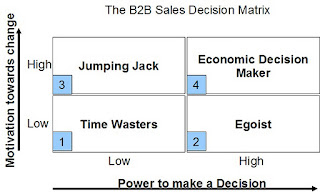
There can be different combinations of the people who have power and motivation to make the decisions:
Lets denote Power as "P" and Motivation as "M". The degrees can be denoted as "h" for High and "l" for Low.
Therefore:
M(l) x P(l) = a person who doesn't have any inclination to do anything for your deal. Simply a time waster, but be careful, this will most probably be the "Gatekeeper"
M(l) x P(h) = the person who has been handed down a senior level job but hasn't been given the authority to take any call on any important implementation that you, with your sales and product, are going to do. Sales people generally always get delayed rejections and mostly no good response from these people. They are known to use phrases like "I have forwarded, now let's see", "We will get back if interested", "Our board will take a call and then I will let you know", etc. Mostly frustrating roadblocks.
M(h) x P(l) = in my domain, this is a faculty member that has all the motivation and fire to make changes happen but doesn't have any kind of power to get anything implemented. However, this kind of person at times can be someone who will possess technical knowhow and can be consulted at a later date. The kind of meetings one gets to have with such a person is always great and sales people come back to me reporting that "Wow, what a meeting", to later recognize the mistake to just anchor all hopes on this guy
M(h) x P(h) = the toughest guy to meet and explain your proposition, but ultimately the one with all the power to sign that deal and cheque for you. The Economic decision maker is the guy who is one with vision and capabilities of implementing the same.
Please remember that all 4 categories are important and therefore should be a part of your account strategy. The fact is that if you have chalked out this strategy for each of your clients, then you will have probably mapped each and every activity and future steps properly. You will know the power relationships and also understand the issues related to each person, their motivation anchors, etc.
This is definitely one of the most important things to sell successfully.
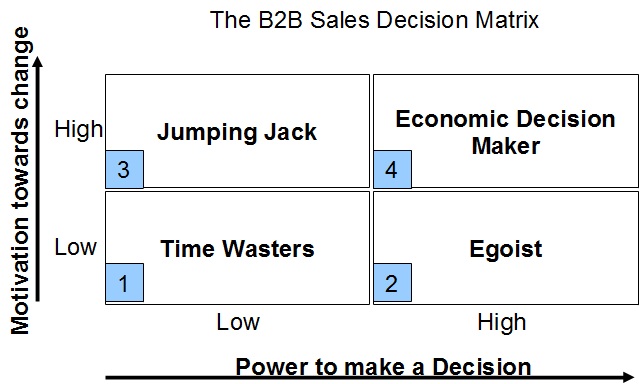
There can be different combinations of the people who have power and motivation to make the decisions:
Lets denote Power as "P" and Motivation as "M". The degrees can be denoted as "h" for High and "l" for Low.
Therefore:
M(l) x P(l) = a person who doesn't have any inclination to do anything for your deal. Simply a time waster, but be careful, this will most probably be the "Gatekeeper"
M(l) x P(h) = the person who has been handed down a senior level job but hasn't been given the authority to take any call on any important implementation that you, with your sales and product, are going to do. Sales people generally always get delayed rejections and mostly no good response from these people. They are known to use phrases like "I have forwarded, now let's see", "We will get back if interested", "Our board will take a call and then I will let you know", etc. Mostly frustrating roadblocks.
M(h) x P(l) = in my domain, this is a faculty member that has all the motivation and fire to make changes happen but doesn't have any kind of power to get anything implemented. However, this kind of person at times can be someone who will possess technical knowhow and can be consulted at a later date. The kind of meetings one gets to have with such a person is always great and sales people come back to me reporting that "Wow, what a meeting", to later recognize the mistake to just anchor all hopes on this guy
M(h) x P(h) = the toughest guy to meet and explain your proposition, but ultimately the one with all the power to sign that deal and cheque for you. The Economic decision maker is the guy who is one with vision and capabilities of implementing the same.
Please remember that all 4 categories are important and therefore should be a part of your account strategy. The fact is that if you have chalked out this strategy for each of your clients, then you will have probably mapped each and every activity and future steps properly. You will know the power relationships and also understand the issues related to each person, their motivation anchors, etc.
This is definitely one of the most important things to sell successfully.

In B2B sales, we are aware of various stages in the sales process and each stage has its own best practices and guidelines. There is a entire process-flow that can be designed to kind of automate the best practices via conversation matrices and pattern-recognition algorithms. So training a sales rep in that direction isn't that hard and most people with good logical-mathematical and interpersonal acumen will pick up things pretty smoothly.
The tougher part is to be a part of the larger picture or answer the "Why?" for your team or even at individual levels.
For across all sections of the industry, there are some large lofty goals that are held close to the hearts of the top-guys (or top-management). I am not saying that these necessarily define the sales goals or the larger picture. Those organization level goals can merely state the direction of the company as a whole and the direction of future products at best.
The "Philosophy" of a sales team and its beliefs based on such a thing is the most difficult thing to establish, but once it's done it will contribute to sales success in ways that are unimaginable. Every-day as we (sales reps) sell and follow the beaten-down processes, we should always be aware that all this are a part of a larger cause.
For super-performing teams and individuals, such philosophy would define their work and the kind of gratification they will derive from such work. So what I am saying is that its doesn't need to be tangible factors like money or perks that can bring out the best, but the philosophy alone will be the factor that has the capability to create word-class teams and exponential results.
I believe that my sales targets are not derivatives of last years numbers, and that I should start with a "zero based" system for every person in my team. I have been asked that in such cases, how is one to identify with the goals and objectives of this year and therefore plan out the stages in sales process! My single-point answer to any such doubt is the "philosophy" that I follow and want to inculcate the same into the teams and people who work in my team. The philosophy alone can allow you to:
(1) Create the mandate for this year and the kind of numbers possible in this year alone
(2) Be objective about all strategic factors, sales plans, revenues, top-grading of sales process, marketing programs, etc.
(3) Recruit "A" players with ease and induct them into the team of performers
I want some of the best suggestions on best practices and research to come from each individual in my team. That's the way super performing teams are made and sustained. I am not a believer that the sales person's job ends when he is done with his work of closing the deal. I am sure he/she will have the accountability beyond that - a fact that can only be identified when the guiding philosophy is something so strong that it inculcates a behavior within the team and individual. No incentive scheme can bring this kind of behavior within any team.
For example:
At present, I am working on the philosophy that - "We will help each b-school in India to top-grade themselves and become world-class Institutions". There are no sales numbers of lingo attached to this statement. But if this is the starting point of my sales process, I will be ethically attached to creating value for the b-schools who are my clients along with my company. I will fight to create some of the best marketing programs that will help me to sell some of the best solutions to their respective needs and have a servicing team that will provide world-class help and suggestions - leading to an amazing result. I know that this whole statement is a large picture that I will help get painted, and I have my own tools to get that done. I will definitely act, think, and implement differently than any other guy in the market or who will meet my clients.
With all things remaining constant (including the best practices in sales and marketing), I will be able to create a niche for myself through my philosophy. Anyone who would join my team will right away be introduced to this idea and I believe that it will then be easy for them to connect to all that I practice and believe in.
So what's a b2b-marketing-program all about? Why do we need something like that, and is there any reason to spend quality time devising marketing strategies that will aid b2b sales?
A major part of our b2b sales goes behind prospecting the right way. A large prospecting bin along with the quality of the prospecting done, goes a long way to define the end results in sales.
I wish to combine this prospecting stage and the account planning mandate together to define a b2b marketing program. Both prospecting and potential account planning are supposed to be brilliant for sales reps who are "A" players. These stages set these people apart from mediocre talent.
Consider the following diagram:
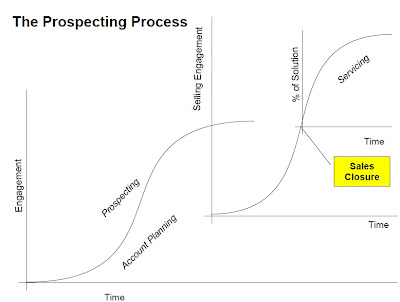
As you can see, the process of prospecting begins way before the real time account planning happens (i.e. when sales reps are meeting people at the clients end and devising resource specific plans). So if you are a sales guy who has a territory and you have already done the following:
(a) Categorized the clients as per spending capacity, buying behavior, usage, technological expertise, etc. and
(b) Identified their needs that are in line with trends and challenges that you can help them solve,
Then you will be required to look into the prospecting stage seriously to ensure that you close more than 75-80% of these prospective clients in your market/territory and also earn the respect and permissions for future sales and servicing.
The Marketing program for such clients who are not into your sales funnel needs to be customized to their individual demographics and psychographics. This is the stage wherein you understand how many people are involved in the decision making process and what are their roles. You also understand at what stages in their learning curves are they functioning that will either help or create bottlenecks for your deal. You will need to know the history of their buying patterns and also understand the kind of media-consumption behavior that they have (for example - do they consume news via newspaper/RSS/websites, etc). You don't want to design webinars for them while they may never sit through such a session at any point in time. You will also need to figure out the motivations for each and every individual as per the role they play in the organization. This is key to customizing messages for them throughout your marketing program.
The marketing program doesn't end at the start of your sales meetings and actually continues into the sales engagement process that you will have for your client. Most times, my sales colleagues misinterpret the sales engagement communications as marketing messages, or vice versa. The point to be noted here is that sales communications are direct and have a different way of consumption. Marketing programs and the related communications will only be support to your sales activities through the sales-engagement phase.
A perfect marketing program will also allow you to preempt all possible issues, bottlenecks, exit points, and therefore you can actually have a Plan A and B for each of the scenarios in place. This is like the game of Chess - you will always have one more move against the opponents moves. Its about understanding and predicting the possible issues that will plague your deal.
A note of caution - Always remember that your involvement in the client's solution doesn't end with the signing of the MOU or the payment for the services. What you have sold them - the "solution" that they are meant to get from your product/organization - begins to take shape after your sales-engagement process ends.
Therefore all communications that are designed for your clients through the marketing program and sales-engagement process should explain at all times the deliverable schedules, expectations, etc. properly so that they never feel that they were lured into buying something that wasn't what was delivered. Therefore, practical data and factors should always be the core of your marketing programs.
Sales reps are the best people to design such programs and therefore I firmly believe that amalgamation of the two functions being served by a single person is the best way forward. Sales and Marketing programs are intertwined and therefore a single mind can plan and execute both the programs perfectly, being accountable at all stages.
A major part of our b2b sales goes behind prospecting the right way. A large prospecting bin along with the quality of the prospecting done, goes a long way to define the end results in sales.
I wish to combine this prospecting stage and the account planning mandate together to define a b2b marketing program. Both prospecting and potential account planning are supposed to be brilliant for sales reps who are "A" players. These stages set these people apart from mediocre talent.
Consider the following diagram:
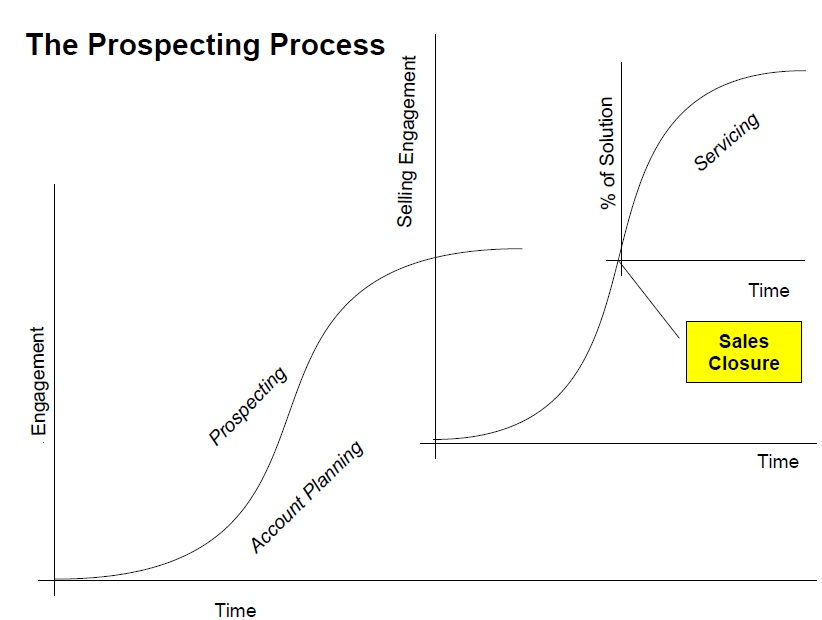
As you can see, the process of prospecting begins way before the real time account planning happens (i.e. when sales reps are meeting people at the clients end and devising resource specific plans). So if you are a sales guy who has a territory and you have already done the following:
(a) Categorized the clients as per spending capacity, buying behavior, usage, technological expertise, etc. and
(b) Identified their needs that are in line with trends and challenges that you can help them solve,
Then you will be required to look into the prospecting stage seriously to ensure that you close more than 75-80% of these prospective clients in your market/territory and also earn the respect and permissions for future sales and servicing.
The Marketing program for such clients who are not into your sales funnel needs to be customized to their individual demographics and psychographics. This is the stage wherein you understand how many people are involved in the decision making process and what are their roles. You also understand at what stages in their learning curves are they functioning that will either help or create bottlenecks for your deal. You will need to know the history of their buying patterns and also understand the kind of media-consumption behavior that they have (for example - do they consume news via newspaper/RSS/websites, etc). You don't want to design webinars for them while they may never sit through such a session at any point in time. You will also need to figure out the motivations for each and every individual as per the role they play in the organization. This is key to customizing messages for them throughout your marketing program.
The marketing program doesn't end at the start of your sales meetings and actually continues into the sales engagement process that you will have for your client. Most times, my sales colleagues misinterpret the sales engagement communications as marketing messages, or vice versa. The point to be noted here is that sales communications are direct and have a different way of consumption. Marketing programs and the related communications will only be support to your sales activities through the sales-engagement phase.
A perfect marketing program will also allow you to preempt all possible issues, bottlenecks, exit points, and therefore you can actually have a Plan A and B for each of the scenarios in place. This is like the game of Chess - you will always have one more move against the opponents moves. Its about understanding and predicting the possible issues that will plague your deal.
A note of caution - Always remember that your involvement in the client's solution doesn't end with the signing of the MOU or the payment for the services. What you have sold them - the "solution" that they are meant to get from your product/organization - begins to take shape after your sales-engagement process ends.
Therefore all communications that are designed for your clients through the marketing program and sales-engagement process should explain at all times the deliverable schedules, expectations, etc. properly so that they never feel that they were lured into buying something that wasn't what was delivered. Therefore, practical data and factors should always be the core of your marketing programs.
Sales reps are the best people to design such programs and therefore I firmly believe that amalgamation of the two functions being served by a single person is the best way forward. Sales and Marketing programs are intertwined and therefore a single mind can plan and execute both the programs perfectly, being accountable at all stages.
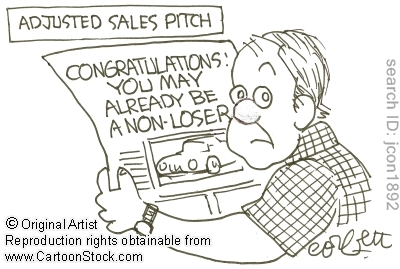
Times changed as did customer profiles. Along with industries that produced for the masses, now there were organizations that created solutions and products for other organizations (Enter B2B sales). With organizations spanning across geographies and sometimes across continents, large sales-forces were witnessed. Training for such sales reps changed as did the sales process to meet the complexities of such buyers and buying process.
What didn't change was the "perceived" motivation for a sales guy.
They were still getting "rewarded" on the premise of the past, wherein the demand of advanced skill sets were already getting implemented through new age sales guys.
This led to a divide amongst sales reps - giving birth to a normalized population wherein there were always judgements on the quality of sales reps across the board (the A players, C players, etc), but not much happened to solve the problem at the right premise.
Some of the brightest kids fresh out of Grad-colleges saw sales as a such a menial job that majority of them shooed away any prospect to join the profession. "Marketing" (an available condition provided to such kids then) came as a packaged profession interspersed with cognitive brain-work, strategic roles, etc that they didn't find in Sales.
Some have argued that Sales isn't a work that can be enjoyed and improved upon throughout one's lifetime. I guess these very people drew the lines and laid down the rules that took this professions by its horns and turned it into a "dirty job" role.
It seems that the best way to get sales reps to do their work is to promise them commissions on the sales quota they achieve, a quota which is already defined by someone else and not the sales person himself/herself. People feel its less brain work and more of "spraying and praying" work that these sales reps master. How can their cognitive strengths match up to other professions like - technology, product designs, editorial/news, (marketing!!), and even finance?
The problem of sales' demise in the middle ages (lets say this was around 25-30 yrs back) has been the kind of people who were chosen to populate the profession. Agreed that there were some of the best brains who actually changed the scenario in the last 30 yrs from the same batch, but most of the lot at that time actually allowed some of the best minds to steer clear of this profession.
Why should anyone join the profession if they find no respect in the kind of work and no quality work happening at any point in time?
Thankfully, all that seems to change now and I believe the profession is set to evolve. Most of what sales reps used to do for their living during those years are now replaced by technology and therefore are obsolete. The core functions still remain but are evolved to a large extent, and everyday, salesreps from across the world are trying to solve larger problems.
However there is a lot that remains to be done and changed:
1) Change perception that one can do sales for a few years and then master marketing (Dream On! Coz it never happens that way. it takes a lifetime to master sales and its completely different from one's perception of learning)
2) Change motivation factors (We are not High Class Hookers who get paid for a performance with a client. We are highly creative, with high logical-mathematical skills/intelligence, and an amazing work ethic+persistence combination)
3) Change the amount of Autonomy given to sales reps. Good quality work doesn't get limited by designations, work experience, hierarchies, etc.
4) Change the ways of development for Sales reps. There won't be over emphasis on pathetic "training" modules with one-size-fits-all approach. Mastery over sales practice needs to be done everyday. Get that as a part of the culture.
5) Change the purpose for the sales reps. Sales is not only to get revenues and profits for the company. It is an ecology that involves the customer, and very often they are ones who bear the brunt of sales-gone-wrong. Higher "Purposes" exist and they need to defined. There needs to be a vision for sales reps in each company - one that will super motivate them to push themselves to the edges of excellence and bring out brilliant work and results without any tangibles promised as a part of the salary.
There is promise of making such things happen at every organization and there is hope that today's sales organizations (kinda micro-organizations inside a company) will be able to implement most of this.

I am sure that we are all eager to control outcomes in our own ways - by designing systems around us, defining processes that have a certain "algo" feel to it, and also by solving our problems (manpower, sales results, etc) via sacrifices of quality work.
The moment my universe/ecology begins to be seem like something based on my definitions and rules, then its easy to feel comfortable and believe that "all is right". This feeling turns out to be momentary in most cases since it takes a large blunder or a case of something not working out, to attract another set of rules and design changes in my working process.
So, there are pertinent questions:
(Q) Do I solve my problems - market share, revenues, manpower etc. by using my definitions and rules?
OR,
(Q) Do I allow my team members to become better everyday through providing them with Autonomy in what they choose to do, finding their own purpose to work, and mastering their skill sets through a customized and well-supported individual learning model?
At most times, a Sales VP would want to solve things (rather control the solutions) by trying to answer the first question. That's probably because its easier to track what I know I can, and therefore it is better that I allow only a certain deviation in systems that I design and control. Else I will probably have to figure out individual plans and a more complex structure to grow my team to be one of the best in the world.
Example:
I want to solve the market-share issue of a particular territory wherein the present team has been getting the low hanging fruits pretty well but hadn't had the time to prospect for the larger volume of clients. I can easily ask the current team guys to take up more work and figure our ways to close more sales in their territory. I know that they have worked hard and can do the job if they are pushed to go after more prospects-per-week and improve conversions.
But, are these team guys interested in such selling process? Are they going to get better by doing such work? Will that let them define larger goals of their quality work?
The easiest thing for a Sales VP and definitely the blunder one can make with the current team is to force solutions into an existing set without bothering about analyzing individual objectives, work-ethics, possibilities, and growth plans.
There ought to be guiding rules and set of expectations that are preset for a team, but pushing in new rules and targets just for the sake of an easier solution for my problem will dis-allow my own people to grow into better talents of future. If there is a need for a new team with a specific skill sets for a new problem then I should get that done properly rather than to push people with different skill-sets and growth-life-cycle into my solution.
If you cannot believe that people develop organically (and not linearly) then you ought to get out more often.
For you to be doing the right thing in marketing, you ought to:
- Do what is needful NOW and what makes sense given the kinds of communications that work TODAY
- Use the best of mediums and tools available TODAY and therefore get the kind of expertise to use such tools
- Look at brilliant user engagement opportunities and design for the results that will give you the kind of revenues you can ACTUALLY achieve rather than what you can hope to achieve this year
At most times, marketing activities are planned based on the following:
- Budget: which is again based on the kind of revenues that one did last year
- Tools: monolithic ones that are considered safe-bets (coz it worked somewhere in the past) while common sense and knowledge tells them to use the new-age media (which actually works)
So with such a premise, most companies can fall into a downward spiral once the economic factors hit them hard and they have bad results (topline) to show. It definitely means cuts in marketing spend, hires in marketing team, and a long list of regrettable decisions.
According to me, an ideal way for any company to look at marketing will be to first set higher goals to achieve as revenues, market shares, etc (which is contrary to common beliefs amongst companies who intend to shoot down ambition first thing post a slowdown) and then figure out the best activities in marketing that one will do to get that kind of sales/revenues.
So if you started with the premise that its a Clean-slate this year and your company can achieve amazing amount of revenues from the available market (as well as new market-share), then you will plan for an amazing and creative marketing program that will get the best results for you.
But the fundamental problem is - How will you fund this marketing program??
The answer is hidden in the way we should look at solving such problems in a way a start-up would. Most startups don't have any money and they generally have to work hard to get working-capital to move up and chain and become a larger player. Most of such startups go for seed-funds or venture-capital which is essentially credit from a certain source.
What if you run your marketing program in this particular way? Get funds/credits from some source and then use it to fund your marketing program of this year. This will not be limited by your last year's revenues and failures in marketing tools. Since you know that you ought to pay back the loan, you will ensure that you are getting to the numbers promised by your team and marketing activities.
So will it be a bank? or a special fund? I really don't have an answer for that, but for me this idea has the potential to solve the larger issues of companies dying out due to a practice of anchoring your future based on your past, whereas they should be looking at making the future work.
The future holds the promise of an evolution in marketing practices, tools, theories, and a whole lot of innovations that will allow companies to engage and connect to their customers in more better ways then ever. If past mistakes/errors and dogmas define the future designs of marketing programs, then there is not much hope. (Example - The way Indian B-schools are shutting down today)

(1) Establishing the premise of 'Status quo"Most clients I have worked with and have successfully closed had one thing in common - they were worried about "maintaining status-quo and failing". It literally means that they didn't want to carry on doing the same kind of work every year to get to desired outcomes. I agree that it takes a lot of inward-thinking to understand that such a thing is necessary, but the good part is that this can also be counseled into their thought-process. One starts with explaining their current set of problems, maps these problems over the next year and then probably 3 years (with all things remaining the same, and others improving) and then predicts with a good amount of certainty on the Results expected. I have seen such a discussion scare the wits out of them.
(2) Providing the "escape"Like all emotionally tired souls who need an escape, these clients too need their own emotional 'blue-lagoon' that promises them real-time solutions to their set of worries. Now its very important that one defines these things for clients openly - Why are they supposed to be looking at certain business success factors? What is the extent of the solution that the client will have once they decide on choosing me? How will it all look when they finish the first cycle with my solution?
People buy emotionally and it doesn't change much once your standard set of deliverable and value-adds have been discussed and understood. The part of the brain that gets activated when the final moments of the decision is to be made, many of my clients have looked back upon the so called "experience" in the overall buying process/discussions process. The Limbic-system (or the cerebral cortex) fires up during these times allowing your actions (including the consultative sales part, the questions that made them think "Wow", etc) become important along with the set of deliverable.
Since you know this, the "escape" from their problems needs to be presented in an impressive and strong way so that it makes an impact. It's something that will take away most of the stress, risks, worries on new-age-tech, and a whole lot more so that decision is all yours.
(3) Reassure them about the "expertise"What's your image in-front of your client? Are you a sales-rep? Do you do things the same way that your most pathetic competition does when they sell? Do you remind them of the kind of (bad) experience they had with another guy who had something similar as a solution? Considering they will be emotional about all these, you can ruin your chances by not setting course on the "Expert" Mode.
You solve the problem by designing the first set of meetings and their objectives that will provide a game-changing experience for the client. You will probably have a longer Phase-1 of your sales cycle, but your Phase-2 (Closure) will happen quicker and without any pricing issues.
(4) Allow them to see the "passion" in your conversationsMost top quality sales guys care for their clients business. If you really do, then please note that this care and passion needs to come out in all conversations, emails, etc so that they know you are taking this seriously. Your knowledge about their business (for my clients, I need to know their application numbers, channels from where they got specific application numbers, improvements in their numbers YOY, new campuses, new programs, issues with regulatory bodies, etc) will allow them to understand that you are deeply involved in this process and you can be trusted with a plan you design for them.
Why else would anyone really bother to look at your plan?? You can't fake this passion (Sorry!) You will need to really worry to make that thing happen
(5) "Paradise" isn't cheap
Many of my clients have asked for abrupt discounts. At most times, such requests were mostly to figure out if I really trusted in what I was selling. Things like - " I get something like this cheaper from X and Y and Z" and I told them - "I don't price my products on someone else's incompetence in understanding value and business". It is not alien that what comes at a cheaper price is also bundled with other bad things, but people want to feel "emotionally" charged when they get something measurably good for their company. At most times, they are appreciated for that. So when the client doesn't understand anything of my product, the best thing he would do will be to get the best of something that he understands - money!
If you have REALLY done the hard work and taken them through the above pointers/stages, then the conversations are much better. Imagine walking into a laptop store with your mother and all she wants to do is to get a deal of 50% off on something you really have researched and know of. How would you feel? Whats the first thought in your mind? Knowledge and emotion is a heady mix that can give you the best advantage. Paradise isn't cheap for anyone.

1. How much time should one take before making the second call (while cold calling)? Why?
2. How many touchpoints, ideally, are required to get the first meeting with the prospect? Why?
3. How many meetings are required for closing an account? Is there a difference in pattern when considering various types of clients? How many hours ideally needs to be spent behind each prospect and why?
4. What are the best opening lines for large accounts? What are the opening lines for new clients or those that don't value your offering?
5. What is the schedule of micro-closures that once should plan for in every meeting in the prospecting phase?
6. What are the pitfalls to avoid to not get anchored into price points/discounts? What are the common mistakes?
7. When does one get to understand that the deal is rotting? When should one keep an alarm for such things?
8. What are the steps for educating a non-digital client?
9. What is the ideal "Deal-Exit-time"? (i.e. when do you know that you ought to exit from all communications of this particular deal and it wont make any more sense trying to talk to them?)
10. What are the best followup mechanisms and content?
11. How do you dislodge people from their own status-quo and initiate their buying process?
12. How do you figure out decision makers (without playing around with people's egos)?
13. How do you figure out what to pitch to the client and how do you know if that's the best for the client? Is there a way to design this?

1) How do you address the complex b2b buying process that can delay deals and hit your sales top-line? How would you design a sales process that will take care of such a complex system and produce conversions?
2) What are the different parameters you would use to identify the market opportunities (market share, revenues, conversions)?
3) What would be your content marketing strategy and how would you map that to the sales prospecting process for your sales-team?
4) What are the important success factors that you would want your sales reps to keep in mind when planning for a quarter? Why?
5) How would you ensure that you provide enough autonomy to your sales reps so that they can plan and implement their own processes with very less deviation from revenue-goals?
6) What would you suggest to your sales team to do for mastering the sales process every-day? How
would you ensure that such a system is scalable?
7) What according to you is the larger purpose for the sales team that should motivate them to go beyond normal performances and strive for brilliant results? How would you define such a purpose?
8) What are the important things that you will check for a sales rep while Hiring?
9) How would you improve on the critical success factors that will affect your top-line, and how will your sales team be involved in this process?
One side of the story revolves around "you". This is where you are responsible for setting individual targets (probably beyond the targets given to you by the company) to earn a certain commission or bonus. For a certain type of sales people who are driven by such impetus, its possible that they hit the targets pretty well (the ones defined by themselves). They consider this as Success. So what transpires post getting to the targets is a calculation of the amount of bonus and commissions that they are to get for their work.
The second part of the story has the "company" at its core. In this part, the complexities of human thinking and company culture mix together to create a rather difficult situation of growth inside the company - for all such salespeople who have performed well. Almost every company who are operating under the "pay-for-performance" mode and at times @100% commissions only salary structure - subscribe to "capping" the bonuses and commissions for their own sales people. So there is a Level 1 cap that is always in place for such a structure.
The Level 2 is defined by the salesperson's choice of target and probably the kind of money they want to make out of their sales revenues.
The problem arises when Level 2 grows beyond Level 1. This will happen when the salesperson starts making more in bonuses and commissions than some of the top-management folks (and definitely the HR, who controls the process and feels people are getting so much more money unnecessarily), and therefore people running the company start wondering "How much money is
actually good money to be paid to such sales reps?"
So the clash between Level 1 and Level 2 invariably brings the following:
1) Frustration for the sales rep
2) Disbelief amongst the work-force
3) Low sales output
4) Loss of good sales players
5) Overall fall in performance of the company
Managing expectations is difficult when you have performers who will go after the numbers set by you (since you really know Nuts about anything related to human potential to defeat numbers), and therefore such clashes are imminent threats to most of those organizations. Gone are the days of door-to-door typewriter selling where the sales-reps had to be good looking and talk-nice/polite and have amazing charm to sell products. Sales reps in today's world are people with high end cognitive skills and are supposed to be innovators in their own way (in terms of new processes, sales systems, models, etc). Building such a commission based system will defeat the purpose of good sales reps and then the inconsistency of companies to live upto the fact that some people will make a lot more money than the company estimated will open the pandora's box of worms and redefine the worth of a salesman.
Isn't this avoidable? and isn't it worth taking a shot at solving such problems at the outset for an amazing sales organization?

I am into helping my clients identify and implement effective communications strategies (online) and then measure+improve such campaigns with the best practices of marketing2.0.
One of troubles that I saw my sales reps face (in the initial days of selling), is that they used to jump into the cliched sales conversations of how if the client uses our products, they will be making a right call and then get good results etc. The focus was only on solution selling. It works for a certain deal size and a certain client type. But as clients improve and more complexities are added into the buying process (aided by more also-ran companies, services, etc), the need to do more than solution selling becomes important.
Since at most times, my clients use my services to address their marketing needs, I ought to understand how some of the best practices in marketing will help them achieve their objectives. Most A-players are worried about their clients business, else the kind of growth in the revenues-per-client will drop drastically.
I need to underline the following while designing the marketing-prospecting stage for them, along with the conversations that I will have with them:
1) The buyer has changed. The persona of the buyer can now be defined as Buyer2.0. I will need to include this fact at the core of all explanations for my client
2) Marketing2.0 includes the best of 360degree branding options. The client needs to understand these options, their characteristics, measurement metrics, and the time needed to be invested
3) Behind using each marketing channel, there is always a specific strategy in mind. Integration of all marketing channels is important and this will help the client to use the synergy of all activities and communications to get to desired objectives (including brand-connect)
4) Content mapping. This is an important part of my prospecting stage anyways, but it also has an important role to play in my client's communications stages. The client needs to understand how content mapping will help in creating a loop that will in-turn help in engagement with the final users
5) Multi-channel attribution and how the mechanism works. This will give my client the idea of how they should map the responses of online/offline communications and how to make sense of the 360degree structure that they are following. This will allow the client to measure and understand the importance of each of those options used in the campaign
It is no longer just enough to understand the product of the client, or the industry. Its pertinent that I am aware of the process end that the client will realize through my services. This kind of engagement goes beyond the normal definitions of sales, but has now become an integral part of the sales-reps work everyday.
New models of such engagement with the client need to be designed everyday by sales reps. This is like creating/curating content, and then sharing for better value. Imagine a sales team wherein every person does this creation/curation of content and then shares it with the team everyday, so that each of those solutions can be referred for designing better value for all our clients.