



Short answer: fewer people registering for CAT 2026 will not hand you an easier percentile. The headcount is down by about 11,000. The swing that actually decides your marks-to-percentile conversion is the paper itself, and that has moved the 99th percentile by up to 19 marks in a single year.
You’ve seen the forward by now. “Registrations down to 2.84 lakh! Cutoffs will drop!” It’s doing the rounds on every Telegram group, every Reddit thread, every mock-discussion WhatsApp chat. And honestly, we get why. With 38 days to go, any news that sounds like good news feels like oxygen.
But before you relax your mock schedule, let’s do what CAT itself asks of you: read the data carefully, and don’t jump to the option that feels right. We pulled seven years of registration numbers, five years of score-vs-percentile data and the basic arithmetic of IIM shortlists. Here’s what it actually says, minus the hype and minus the panic.
The number everyone is forwarding
CAT 2026 drew about 2.84 lakh registrations, down 11,000 (3.7%) from 2.95 lakh last year. It’s the second straight fall since the 2024 peak of 3.29 lakh. Zoom out, though, and the picture is far less dramatic than the forwards suggest.
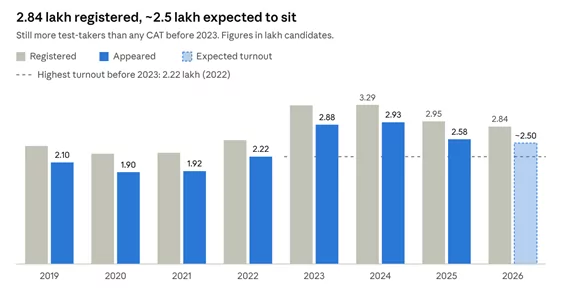

The 2023–24 boom was the outlier, not the new normal. Even the shrunken 2026 pool is larger than anything CAT saw before 2023, when plenty of people still cracked 99 and walked into IIMs.
Registered is not the same as “in the hall”
Your real competition is the number who show up, and that has been 11–17% smaller every year since 2019 than the number who register. Last year 2.95 lakh registered but only about 2.58 lakh actually sat the exam. For CAT 2026, the expected turnout is roughly 2.5 lakh.
Think about who makes up that gap. The friend who registered “just to see”. The final-year student who got a campus offer in October. The working professional whose appraisal cycle ate their prep. They paid the fee, but they were never really your competition.
So the headline number shrank by 11,000. The number that matters shrank by a few thousand, and most of those few thousand were never going to be anywhere near the 95th percentile. Keep that in mind; it comes back later. (Need the full calendar? Admit cards drop on November 4 and the exam is on November 29, everything’s on our CAT 2026 exam page.)
Your percentile is a share, not a headcount
A 99th percentile means you beat 99% of the people in the hall, whether the hall holds 2.9 lakh people or 2.5 lakh. Shrink the room and the top 1% shrinks with it. With about 2.58 lakh appearing last year, the 99th percentile was roughly the top 2,580 candidates. At an expected 2.5 lakh this year, it’s roughly the top 2,500.
That is the bit the WhatsApp forward skips. Fewer people in total also means fewer people above you, below you, and level with you — in the same proportion. A smaller pool doesn’t hand you a free percentile; it just makes every percentile band a little less crowded.
The marks you need to reach that band are a different question altogether. And that question has almost nothing to do with headcount.
What actually moves your marks: the paper, not the crowd
The marks needed for a 99th percentile have swung between 76 and 98 in five years, and the size of the crowd explains almost none of it. Put the two side by side and the pattern you’d expect from the WhatsApp forward simply isn’t there.
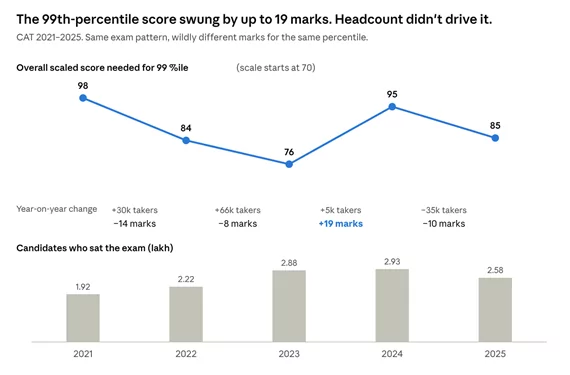

Collegedunia and Coachify post-result compilations (overall scaled scores); MBAUniverse for candidates appeared · CAT 2021–2025
Look at 2023 to 2024. The number of test-takers barely moved, yet the 99th-percentile score jumped by 19 marks because CAT 2024 was a friendlier paper. Now look at 2021 to 2022: 30,000 more people sat the exam, and the 99th-percentile score still fell by 14.
The lesson is simple. Percentile is decided by how hard the paper is and how the whole room handles it. Eleven thousand fewer registrations won’t move the needle the way one tough DILR set will. Want to see how the sections behaved year by year? Our CAT score vs percentile tracker breaks it down.
Okay, so where does a smaller pool help? A little, lower down
There is one honest version of the “fewer people” argument, and it’s worth knowing. IIM seats don’t shrink when test-takers do. If an institute wants to call roughly the same number of people for interviews, a smaller pool means it has to dip slightly deeper into the percentile list.
Here’s that arithmetic for two illustrative shortlist sizes. These are not real IIM numbers, just a way to see how sensitive the line is.
|
|
|
|
|
|
If an institute calls… |
2.93 lakh appear (2024) |
2.58 lakh appear (2025) |
~2.5 lakh appear (2026, expected) |
|
3,000 candidates (a top-IIM-sized list) |
98.98 %ile |
98.84 %ile |
98.80 %ile |
|
15,000 candidates (a mid-tier-sized list) |
94.88 %ile |
94.19 %ile |
94.00 %ile |
At the top, the line moves by about 0.2 percentile, a couple of marks at most, and well inside what one silly error in a TITA question costs you. In the 94–95 band it moves closer to 0.9 percentile, which is a real but modest tailwind for mid-tier calls.
Two big caveats. First, IIMs publish minimum percentile cutoffs as policy, and those don’t loosen because the headcount dipped. Second, the shortlist is a composite, your Class 10, 12, graduation, work experience and diversity points all count. Before you bank on any of this, check how your target schools actually score you on our IIM shortlisting criteria guide.
So who is actually leaving?
Nobody publishes data on who didn’t register, so treat this section as informed reasoning, not fact. But the likely answer is: mostly not the people you’re competing with for a 95+.
The reasons analysts have pointed to since last year’s dip are a decent job market for fresh graduates, flagship IIM fees now sitting around ₹21 lakh, and a crowded calendar of NMAT, SNAP and XAT. Add last season’s admissions mess, revoked offers, re-issued result lists, and you can see why a casual aspirant might sit this one out.
Every one of those pressures hits the undecided aspirant hardest. The person who has already taken 20 mocks, tracked their DILR accuracy and planned their slot strategy is not deterred by a fee hike. If anything, the 2026 pool is likely to be a little more serious, not less. That’s not a reason to panic. It’s a reason not to coast.
What to actually do with the next 38 days
If the registration number changes nothing about your marks, what does move them? Things you control. Here’s where the data says to put your energy.
- Stop targeting a fixed score. Target a percentile. The marks for 99 percentile have ranged from 76 to 98 in five years. Your mock percentile against a serious test series is a far better compass than “I need 90 marks”.
- Train for a tough paper and an easy paper. Take at least two mocks before Nov 29 that feel brutal, and practise leaving In a 2023-style paper, smart skipping is what got people to 99 with 76 marks.
- Protect your weakest section. IIMs use sectional cutoffs, and no amount of headcount maths rescues a sectional miss. One extra set of DILR a day is worth more than any forward.
- Lock your logistics early. Download the admit card the day it drops on Nov 4, check your name and ID match, and do a trial run to your test centre. Our admit card checklist has the rest.
- Mute the noise for 38 days. Registration counts, “expected cutoffs” and topper reels are other people’s anxiety. Your mock analysis is your data. If you want a sane space to discuss it, the CAT 2026 discussion group on PaGaLGuY is right here.
Forward this instead
The next time someone drops the “cutoffs will fall” message in your group, reply with these five lines.
- About 11,000 fewer people registered. Around 2.5 lakh will actually sit the exam.
- Percentile is a share. A smaller hall shrinks the top 1% too.
- The paper’s difficulty moved the 99th-percentile score by 19 marks between 2023 and 2024. Headcount barely moved at all.
- At the very top, a smaller pool shifts the shortlist line by about 0.2 percentile. That’s a rounding error, not a strategy.
- The pool getting smaller probably means the pool getting more serious. Don’t coast.
Fewer aspirants, same anxiety, and the same exam. See you on the other side of November 29.
Connect with alumni and students for insights. Join: CAT 2026 Exam Preparation, Discussion | PaGaLGuY